The Plaintiff Guide to Nonprofit Plaintiff Funding
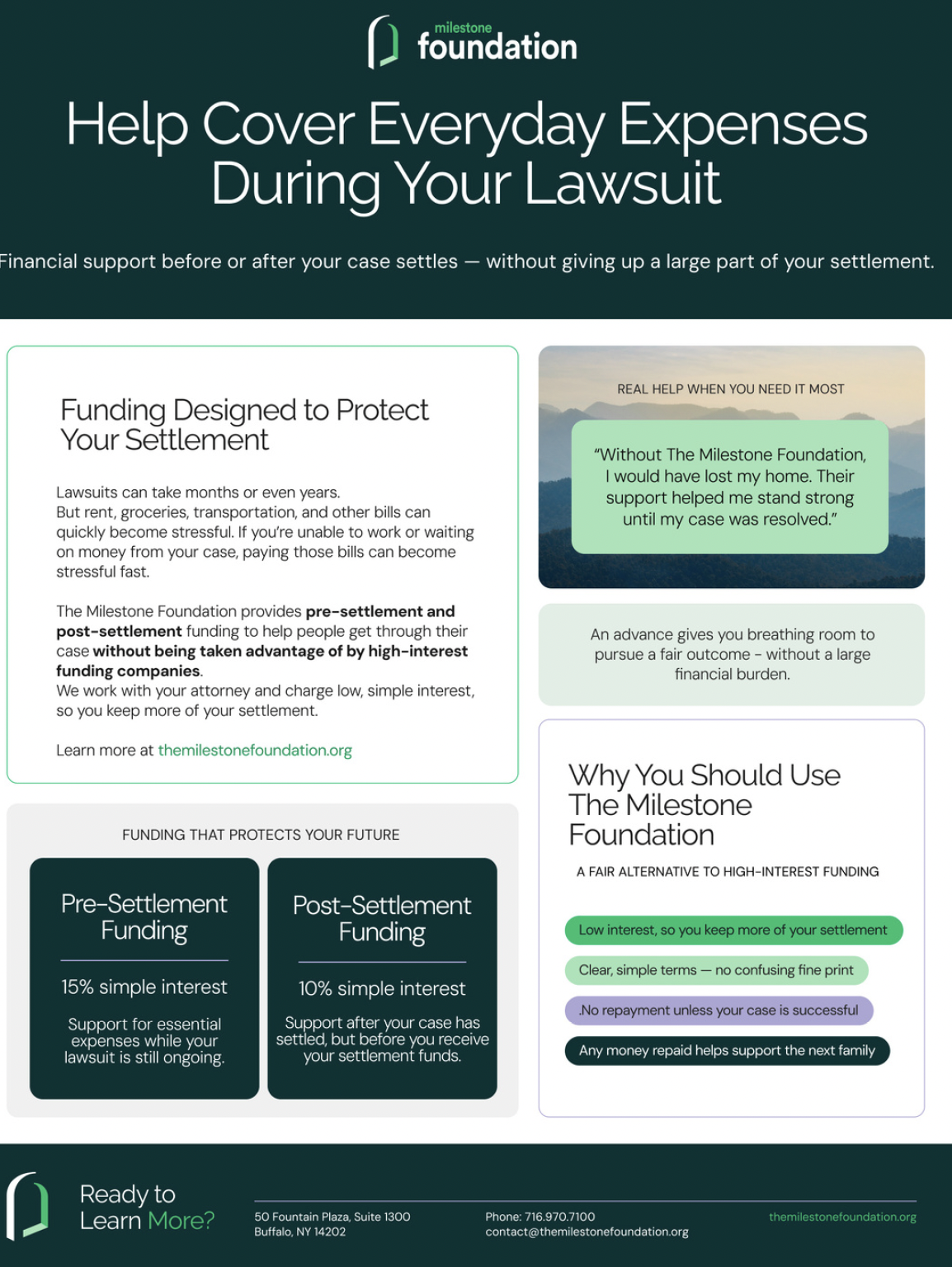
This one pager is a resource to provide to clients considering pre-settlement or post-settlement funding. It offers an overview of The Milestone Foundation and explains how its nonprofit model differs from other plaintiff funding companies.
Attorney Resources for Ethical Litigation Funding
For plaintiff attorneys, the right funding resource should help you evaluate options, educate a client, and protect the integrity of the case. This hub brings together practical guidance on funding terms, the referral process, state-specific research, and ways to support access to justice. The Milestone Foundation is the first and only 501(c)(3) nonprofit consumer litigation funding organization. Its mission-driven model gives attorneys a transparent alternative to traditional for-profit funding when a client needs help with essential expenses during litigation.
Pre-settlement funding is offered at 15% simple annual interest, and post-settlement funding is offered at 10% simple interest. Interest never compounds. Funding is non-recourse, so a plaintiff owes nothing if the case is lost. Attorney participation and acknowledgement are part of the current process, while legal strategy and settlement decisions remain with the attorney and client.
Understanding the Nonprofit Funding Model
Simple interest is calculated on the original advance amount. For example, if the principal stays the same, the interest calculation does not grow by adding prior interest to the balance. Compound interest works differently because each new interest charge can be calculated on accumulated interest as well as the original principal. Understanding that difference helps attorneys explain why the structure of an advance matters over the life of a case.
The Milestone Foundation uses simple interest and states that interest never compounds. The nonprofit model is designed to provide breathing room for plaintiffs who need help with essentials such as housing, utilities, food, transportation, or medical-related needs while a case proceeds. The goal is to reduce financial pressure that could otherwise push a plaintiff toward an early or unfair settlement, not to influence legal strategy or the value of a claim.
Transparency also means reviewing the complete agreement before a client accepts funding. There are no hidden fees. Attorneys and clients should still read the written terms carefully, ask for a repayment example using the proposed advance and expected timing, and confirm what happens if the case does not resolve. Funding is non-recourse, which means the plaintiff owes nothing if the case is lost under the current Foundation model. Attorneys can also review the attorney funding FAQs for additional general information.
Questions Attorneys Should Ask About Funding Terms
- What advance amount does the client need, and is it limited to an essential financial need?
- Is the charge based on simple interest or compound interest?
- What would the total repayment be under realistic settlement timelines?
- Are all fees identified in the written agreement, with no hidden fees?
- How does the non-recourse provision work if the plaintiff loses the case?
- Does any term attempt to control litigation strategy, settlement decisions, or attorney judgment?
- Can the client explain the amount, timing, and repayment terms in their own words?
How Attorneys Can Refer a Client
A referral should be an informed, voluntary option, not a recommendation that a client borrow more than needed. Attorneys can use the following workflow to keep the process clear and aligned with client-centered representation:
- Discuss the client’s essential financial need and explain that funding is optional. Consider whether an advance would help the client manage necessary expenses without changing case strategy or settlement judgment.
- Direct the client to the official application for nonprofit funding. The client can review the application information and decide whether to proceed.
- Expect The Milestone Foundation to coordinate directly with counsel to confirm case details. Attorney participation and acknowledgement are part of the current process. Counsel remains in control of legal strategy, and settlement decisions remain with the attorney and client.
- Review the funding terms with the client in plain language. Keep the agreement, repayment explanation, and related communications organized with the case file.
According to the current Foundation information, pre-settlement funding requests take one business week on average for review. Post-settlement requests can be reviewed the same day. If approved, funds can be provided within 1-2 business days. These are process expectations, not a promise of approval or a result in any individual matter.
State-by-State Litigation Funding Regulation Resources
State and federal rules can change, and funding questions may also involve court rules, professional obligations, and proposed legislation. This section is an educational index, not legal advice. Counsel should confirm current statutes, court rules, disclosure requirements, and proposed legislation before advising a client or selecting a funding arrangement.
A useful review framework is to identify the current law, separate proposed legislation from enforceable rules, review any disclosure requirements, assess conflicts and litigation-control provisions, and document the client’s understanding. The following state resources provide starting points for further research without replacing current legal analysis:
- Texas litigation funding regulations
- Illinois litigation funding regulations
- Ohio litigation funding laws
- Pennsylvania litigation funding regulations
- New Jersey litigation funding regulations
- Michigan litigation funding rules
Partners for Justice Membership
The Partners for Justice membership program is for attorneys and firms that support fairness, transparency, and client-centered advocacy. Membership can help a firm demonstrate its commitment to ethical funding while contributing to a broader community of legal professionals working to expand access to justice.
Current program information describes benefits such as recognition, educational resources, and participation in a national community advancing ethical funding. Review the program details and current terms directly rather than relying on an outdated summary. Join the Partners for Justice Membership Program to learn how your firm can participate.
Cy Pres Opportunities to Expand Access to Justice
Residual class-action settlement funds may be directed by a court to an organization whose mission aligns with the case, subject to court approval. A Cy Pres designation can extend the impact of a settlement when funds cannot be distributed directly to individual class members.
Designating The Milestone Foundation can support fair, non-recourse funding for plaintiffs facing essential expenses during litigation. The Foundation is a 501(c)(3) nonprofit, and a designation should be evaluated in light of the case, the proposed distribution, and applicable court requirements. A designation does not guarantee that a court will approve it. Attorneys can learn about Cy Pres designations and the current process.
An Attorney Resource Checklist
Before discussing or referring a funding option, use this checklist to organize the conversation:
- Confirm the client’s financial need, voluntariness, and understanding of available options.
- Explain that attorney participation and acknowledgement are part of the current process.
- Review the proposed advance amount and a repayment calculation using realistic timing.
- Confirm that the charge uses simple interest and that interest never compounds.
- Review every stated fee and confirm that there are no hidden fees.
- Explain the non-recourse terms and what happens if the plaintiff loses.
- Review language about litigation control, settlement decisions, attorney judgment, and client communications.
- Identify applicable state and court disclosure rules, and confirm current guidance before advising the client.
- Keep the application, agreement, repayment example, acknowledgements, and communications organized.
Use these resources to help a client make an informed decision while keeping the case and the client’s interests at the center. For attorney partnership questions, Explore Attorney Partnerships.