
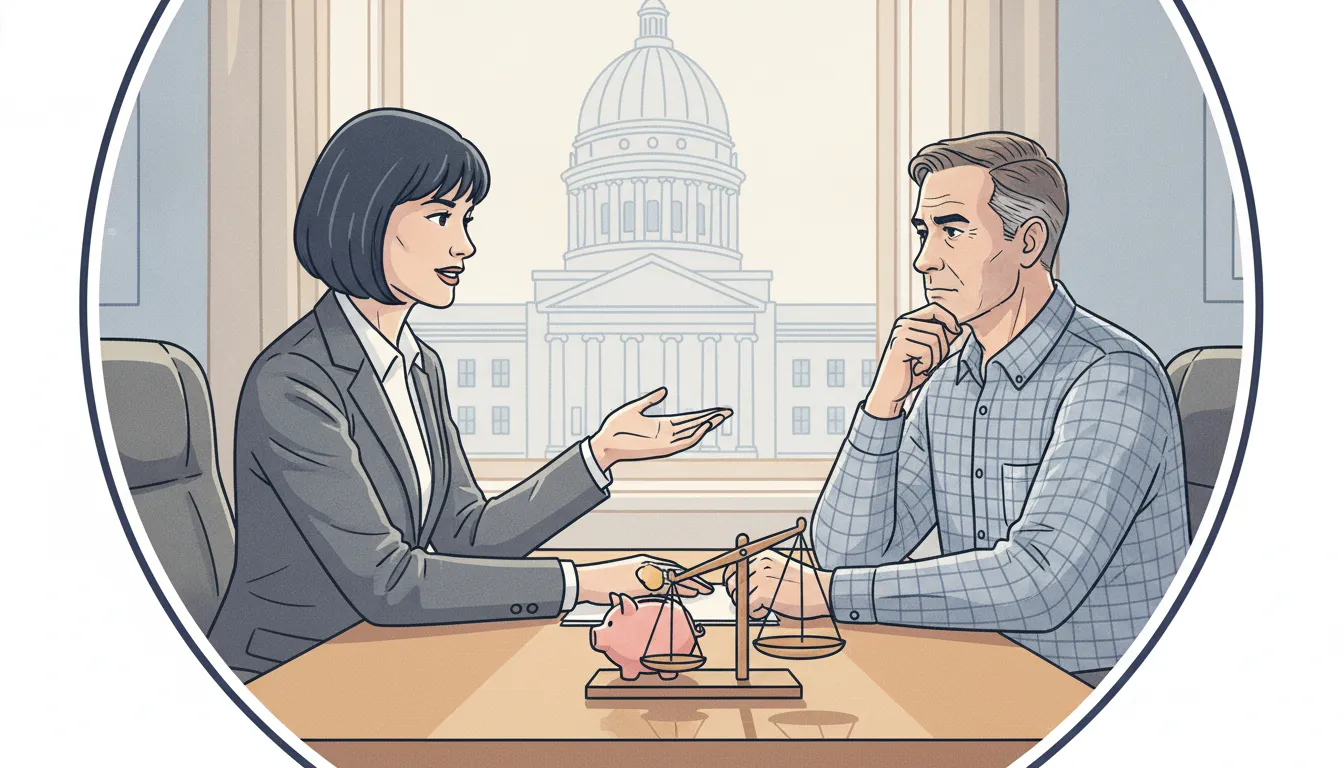
When a client needs financial stability during a pending case, an attorney must evaluate more than whether funding is available. The agreement, cost structure, client understanding, potential conflicts, and any applicable court or legislative developments all deserve careful review. Iowa-specific conclusions should be based on current primary sources, not assumptions drawn from another state’s rules or from a funder’s marketing.
Explore attorney-aligned funding resources
Explore Attorney-Aligned Funding Resources
For attorneys reviewing Iowa litigation funding options, The Milestone Foundation is the first and only 501(c)(3) nonprofit consumer litigation funding organization. Its model emphasizes transparent terms and client-centered decision-making. Pre-settlement funding uses 15% simple annual interest, while post-settlement funding uses 10% simple interest. Interest never compounds, and funding is non-recourse, so a plaintiff owes nothing if the case is lost.
Attorney participation is required for plaintiff funding applications. Attorneys can review the agreement with the client, confirm that the client understands the financial consequences, and keep funding separate from litigation strategy and settlement decisions.
Iowa litigation funding regulations should be reviewed alongside the proposed legislation, federal court disclosure and discovery practices, and the specific terms of each agreement. Proposed bills are not the same as enacted law, so attorneys should confirm the current position with qualified Iowa counsel and assess whether the funding preserves the client’s informed decision-making.
That review begins by separating what Iowa law and court practice currently require from proposals that could change the compliance landscape, then applying those distinctions to the agreement in front of you.
Iowa Litigation Funding Regulations: What Should Attorneys Review?
For attorneys evaluating Iowa litigation funding regulations, the first review step is separating current law from proposed legislation. The available Iowa bill records identify SSB 1122 as a proposed act regulating litigation financing contracts. It was introduced and referred to the Senate Judiciary Committee on February 13, 2025, rather than identified in the cited record as an enacted statute. The proposal called its proposed chapter the Litigation Financing Transparency and Consumer Protection Act and defined covered consumers broadly, including people who reside, are present, or are domiciled in Iowa and people pursuing claims in the state.
That distinction matters. A proposed disclosure, contract, licensing, or consumer-protection requirement should not be described as an Iowa requirement until it has been enacted and its effective date confirmed. Attorneys should check the current Iowa Code, official bill history, applicable court rules, and the posture of the specific case before advising a client or reviewing a funding agreement. For broader context, compare these litigation funding disclosure rules, while keeping in mind that general guidance does not establish Iowa law.
In practical terms, review the agreement’s parties, repayment language, disclosures, confidentiality provisions, control terms, and any potential conflict with the attorney’s duties. Confirm that the client understands the financial consequences and that the arrangement does not interfere with litigation strategy or settlement decisions. Funding terms are not the same as state-law requirements, and a funder’s nationwide terms do not establish an Iowa rate cap or licensing rule.
This is educational information, not legal advice. Iowa law and legislative status can change, so counsel should verify the current primary sources and obtain jurisdiction-specific advice before relying on any conclusion.
Is Consumer Litigation Funding Prohibited in Iowa?
Proposal history does not, by itself, establish that consumer litigation funding is prohibited in Iowa. A 2026 legal compendium reports that Iowa lawmakers introduced Senate File 2085 during the 2022 regular session, describing the proposal as one that would have prohibited litigation funding contracts. That is legislative history, not evidence that the proposal became an enacted prohibition. The compendium identifies the measure as SF 2085 from the 89th General Assembly.
That distinction matters when reviewing state-level consumer litigation funding regulation. A bill may be introduced, referred, amended, deferred, or not enacted. Attorneys should confirm the current status of any Iowa measure through official legislative records and review the law applicable to the specific case, agreement, and forum. The available customer materials do not establish an Iowa statute, licensing rule, rate cap, or categorical ban.
Keep the conclusion narrow
The careful conclusion is not that every funding arrangement is permissible, nor that Iowa law imposes no relevant obligations. It is that the existence of an earlier prohibition proposal does not prove that Iowa enacted one. Counsel should check current Iowa law and any applicable court rules before advising a client or evaluating an agreement. This is especially important because state requirements and federal-court procedures can differ.
Agreement review should also focus on the actual terms. The Milestone Foundation describes its pre-settlement funding as non-recourse, with 15% simple annual interest that does not compound. Its post-settlement funding is described as 10% simple annual interest, also never compounding. Attorney participation or verification is required for pre-settlement applications. These terms describe the Foundation’s model, not a statement of Iowa law. For a broader framework, see what makes consumer litigation funding ethical, and have qualified counsel confirm the current legal position before proceeding.
What Iowa’s Proposed Bills Could Change
Legislative activity can affect how attorneys review funding arrangements, but a bill is not automatically law. The Iowa Legislature’s official PDF describes SSB 1122 as a proposed act regulating litigation financing contracts and identifies a proposed “Litigation Financing Transparency and Consumer Protection Act” in chapter 537C. The text should therefore be treated as a proposal, not as a current Iowa requirement. The official SSB 1122 PDF and bill history are the appropriate starting points for checking the source and status.
| Review point | Current review posture | SSB 1122 proposal | 2026 SF 2419 listing | Practical attorney action |
|---|---|---|---|---|
| Legal status | Do not treat either identified item as enacted law based on the available legislative records. | Introduced and referred to Judiciary on February 13, 2025; the history also lists a subcommittee. | The Iowa Legislature page lists LSB 2128 as SF 2419, “Litigation Financing, Regulation,” on February 19, 2026. | Confirm the current status before relying on a proposal in an agreement review or client communication. |
| Potential scope | Review the actual agreement, client circumstances, and applicable current authority. | The introduced text addresses litigation financing contracts and defines covered consumers and entities. | The listing identifies a subject, but the listing alone does not establish the bill’s operative requirements. | Read the primary text and any amendments rather than inferring duties from a headline or summary. |
| Client guidance | Explain what the signed agreement actually says, without presenting proposed rules as binding. | Potential requirements remain subject to the legislative process and final text. | Further details should be verified from the official legislative record. | Document the review date and seek qualified Iowa counsel for a current-law determination. |
For attorneys evaluating Iowa litigation funding regulations, the safest workflow is to separate enacted authority from legislative monitoring. Recheck the official records when a matter is active, and avoid promising that a proposal will become law or describing its introduced language as a final rule.
What Iowa Federal Courts Say About Funding Discovery
Iowa state regulation and federal court procedure address different questions. A state legislature may propose requirements for funding agreements, disclosures, or funder conduct. A federal court, by contrast, decides discovery disputes under the rules and orders governing the particular case. Attorneys should not treat a federal discovery ruling as a complete statement of Iowa’s consumer-funding law.
The leading Iowa federal discussion identified in the available research is Nunes v. Lizza, a Northern District of Iowa case decided October 26, 2021. The ALFA International compendium describes the case as involving a motion to compel discovery about third-party litigation funding. Its summary reports that funding information is generally irrelevant to proving a party’s claims or defenses. That does not create an absolute privilege or a categorical bar.
According to the same compendium, additional discovery may be appropriate after a sufficient factual showing of “something untoward” in the case. The court therefore used a case-specific analysis and permitted discovery subject to in-camera inspection when the defendants raised legitimate subjects for inquiry beyond an ordinary personal-injury case. The practical lesson is narrow: a request should be tied to a concrete, fact-based issue, not a general demand for a plaintiff’s funding file.
The ALFA summary also states that parties in Iowa federal court must file disclosure statements at the outset of a case, citing N.D. Iowa and S.D. Iowa Local Rule 7.1. Counsel should confirm the current local rule, its scope, and any judge-specific requirements before relying on that summary. For a broader framework, review these litigation funding disclosure rules, then evaluate the specific pleadings, discovery request, and court order with qualified counsel.
How Should Attorneys Review an Iowa Funding Agreement?
A careful agreement review helps separate the funder’s actual terms from broader questions about Iowa litigation funding regulations. The checklist below is an educational starting point, not individualized legal advice. Confirm current Iowa requirements and any court-specific obligations with qualified counsel.
- Identify every party and the transaction’s purpose. Confirm the plaintiff, funding provider, and any other named party. Check that the agreement accurately describes whether the advance is pre-settlement or post-settlement, and that the client understands the transaction is separate from the attorney-client relationship. Do not assume a provider’s nationwide operation establishes any particular Iowa legal status or exemption.
- Calculate the amount and interest in plain language. Record the amount advanced, the interest rate, when interest begins, and how repayment is calculated. Ask whether the rate is simple or compound, whether any fees apply, and whether the balance changes over time. For example, The Milestone Foundation describes pre-settlement funding at 15% simple annual interest and post-settlement funding at 10% simple interest, with interest never compounding. Those are the Foundation’s stated terms, not an Iowa rate cap or legal requirement. The client can review the provider’s current terms at the funding application page.
- Confirm the outcome if the case does not succeed. Look for clear non-recourse language. The Foundation describes its pre-settlement funding as non-recourse, meaning the plaintiff owes nothing if the case is lost. Verify that the written agreement matches that explanation and identify any defined exceptions rather than relying on a sales summary.
- Review control, conflicts, and professional independence. Check whether the funder receives decision-making rights, settlement approval rights, communications, or access to privileged material. Consider whether any term could affect the attorney’s independent judgment, confidentiality duties, or the client’s authority to accept or reject a settlement.
- Document disclosures and attorney participation. Identify every disclosure the agreement requires and determine whether applicable Iowa or federal practice creates additional obligations. The Foundation states that attorney representation and participation or verification are required for pre-settlement applications. Attorneys can also review its attorney resources while checking the agreement against current rules.
- Test the client’s understanding before signing. Ask the client to explain the advance amount, repayment calculation, loss outcome, material disclosures, and who controls case decisions. Resolve unanswered questions in writing, and give the client appropriate time to consider the agreement without pressure to borrow.
How Fair Funding Supports Client Decision-Making
Financial pressure can affect how a client evaluates medical care, household expenses, and settlement proposals. A funding option should give the client breathing room without replacing the attorney’s role or creating pressure to borrow. The Milestone Foundation is the United States’ first and only 501(c)(3) nonprofit consumer litigation funding organization, offering a mission-driven alternative to traditional for-profit funders.

Clear terms, separate from Iowa law
The Foundation’s terms are its own funding terms, not a statement of what state litigation funding regulations require in Iowa. Attorneys should review current Iowa law and any applicable court rules separately. For eligible pre-settlement funding, the Foundation states a 15% simple annual interest rate. Post-settlement funding is offered at 10% simple interest. In both cases, interest never compounds, so unpaid interest does not generate additional interest.
Supporting informed, voluntary choices
Funding is non-recourse, meaning the plaintiff owes nothing if the case is unsuccessful. The Foundation also states that it does not charge hidden fees. These features can help a client understand the potential cost and make a decision based on actual needs rather than an unclear or escalating balance. The goal is not to encourage borrowing. It is to provide a transparent option when financial hardship could otherwise push a client toward an unfair settlement.
Attorney participation is required for pre-settlement applications, including representation and verification. That involvement gives counsel an opportunity to discuss the client’s circumstances, explain that funding is voluntary, and consider whether the arrangement fits the client’s interests. A careful review of the agreement, total repayment amount, and case status keeps the decision client-centered.
A Practical Iowa Litigation Funding Review Checklist
Before discussing a funding agreement with a client, document what is known, what remains uncertain, and which rules govern the case. This checklist is designed to support careful review, not replace advice from qualified Iowa counsel.
- Confirm the legal posture. Identify whether the question concerns Iowa state law, a proposed bill, or federal court procedure. SSB 1122 was introduced and referred to the Iowa Senate Judiciary Committee on February 13, 2025; its proposed provisions should not be treated as enacted law. The Iowa Legislature also lists a 2026 litigation-financing bill request, so verify current status through official sources before relying on either measure.
- Review the agreement itself. Record the parties, amount advanced, repayment trigger, interest calculation, termination provisions, and any fees. Confirm whether interest is simple or compound, and avoid assuming that a funding provider’s terms describe Iowa’s legal requirements.
- Check the outcome and control terms. Ask whether the funding is non-recourse, who controls litigation and settlement decisions, and whether the agreement creates any conflict with counsel’s duties or the client’s informed choices.
- Separate state and federal questions. In Iowa federal court, disclosure statements and case-specific discovery may raise different issues. Review the applicable district’s current local rules and the facts of the case, including Nunes v. Lizza, rather than applying a broad rule from another jurisdiction. For background, compare these litigation funding disclosure rules with current primary authorities.
- Document client understanding. Explain costs, risks, and alternatives in plain language. Attorney participation or verification is required for The Milestone Foundation’s pre-settlement applications, but that product requirement is distinct from Iowa law.
Because legislative and court requirements can change, seek current legal review before making a jurisdiction-specific conclusion. For a broader comparison, see the guide to state-level funding regulation.
Contact The Milestone Foundation
Frequently Asked Questions
Are litigation funding contracts prohibited in Iowa?
Do not assume that prior proposals created a current prohibition. An ALFA compendium reports that Iowa lawmakers proposed a bill in 2022 that would have prohibited litigation funding contracts. But that history is not the same as an enacted ban. Attorneys should verify the current Iowa statutes and any applicable case law before advising a client. Review the reported legislative history.
Did Iowa enact SSB 1122?
SSB 1122 was introduced and referred to the Iowa Senate Judiciary Committee on February 13, 2025, according to the Iowa Legislature’s bill history. The proposal would have regulated litigation financing contracts under a proposed chapter called the Litigation Financing Transparency and Consumer Protection Act. Its introduced language should not be described as current law without confirming later legislative action. Check the Iowa Legislature bill history.
Can a defendant discover a plaintiff’s funding information in Iowa federal court?
Possibly, but discovery is fact-specific. The ALFA summary of Nunes v. Lizza reports that funding information is generally irrelevant to proving claims and defenses, while discovery may be allowed after a sufficient factual showing of something untoward. The court’s analysis was case-specific and included in-camera inspection, so attorneys should assess the pleadings, discovery request, and governing local rules.
What should an attorney review in a funding agreement?
Review the funding amount, interest calculation, repayment trigger, non-recourse terms, client obligations, control provisions, confidentiality language, conflicts, and any disclosure or court-order implications. Confirm that the client understands the agreement and that funding does not pressure litigation or settlement decisions. Because Iowa legislation and federal practice can change, obtain current legal guidance for the specific matter.
Contact us to discuss next steps
A careful review can help attorneys evaluate whether a funding option fits a client’s circumstances, fiduciary responsibilities, and need for transparent terms. To discuss attorney-aligned consumer litigation funding options for a client, contact The Milestone Foundation. Our team can help you explore the available information and determine what questions should be addressed with qualified counsel under current Iowa law.