

November 4, 2026

Post-Settlement Funding Rates: Simple Interest, Repayment, and Questions to Ask

Post settlement funding rates can help you estimate what may be repaid after a settlement is reached but before the proceeds are available. The percentage alone is not the full cost: the interest method, the dates used, and the written agreement all matter. A careful comparison can help you understand the possible repayment amount before deciding whether to proceed.

Ask the Foundation about its post-settlement funding terms

What does a post-settlement funding rate tell you?

Post-settlement funding is an advance considered after a settlement has been reached but before proceeds are distributed to the plaintiff. There may still be paperwork, lien resolution, approvals, or other distribution steps. A rate describes how a charge is calculated over time; it does not, by itself, tell you the total that may be due on a particular date.

The Milestone Foundation is a 501(c)(3) nonprofit litigation funding company. It states that its post-settlement funding is offered at 10% simple annual interest, and that interest never compounds. Those are the Foundation’s stated terms in general, not an individual quote or a promise of approval, timing, or a particular amount. Read the written offer and agreement for the terms that apply to your situation.

The word “annual” identifies a year as the rate period. It does not mean that you can calculate an exact payoff without knowing the agreement’s start date and method for counting time. Ask what amount the rate applies to, what event starts the calculation, and how partial months or days are handled. Those details turn a headline percentage into a useful estimate.

For general background on federal tax-exempt organizations and 501(c)(3) terminology, the Internal Revenue Service website is an authoritative government starting point. An organization’s nonprofit status does not replace the need to review the rate, calculation, and other terms in a particular written offer.

How does simple interest affect the amount you may repay?

Simple interest is calculated on the original amount advanced. Interest that has already accrued is not added to the base for calculating later interest. In a basic illustration, multiply the original advance by the annual rate and the portion of a year covered.

For example, with an illustrative $5,000 advance at 10% simple annual interest, a full year of interest would be $500 if the agreement used a straight-line annual calculation on that basis. A straight-line six-month illustration would be $250. That produces illustrative totals of $5,500 after a year or $5,250 after six months, before any other terms. These figures show the arithmetic only. They are not an offer, payoff quote, or prediction for a particular case.

Under a compounding method, accrued interest may be added to a balance and then included in the base for a later interest calculation. With simple interest, the base remains the original advance instead. That difference matters as time passes. Simple interest can still accrue over time, so it does not mean the amount stays unchanged; it means the calculation does not apply interest to prior interest.

Actual contract calculations can differ from a simple illustration. An agreement may specify the start date, the day-count method, whether partial periods are prorated, and the point through which interest is calculated. Ask for a written payoff estimate for a specific date rather than assuming an example gives the amount due on your expected distribution date.

Calculator and settlement paperwork arranged for a repayment review

What should you compare besides the percentage?

Compare the amount you would actually receive with the estimated total due on the same proposed payoff dates. A comparison can mislead if one estimate assumes a shorter period, a different advance amount, or a different fee treatment. Ask each provider to state the assumptions behind its figures.

Post-settlement funding comparison
Item Details
Rate and method Illustrative example: 10% simple annual interest in an illustration
What to confirm in writing: Whether the rate is annual, simple, and noncompounding
Original advance Illustrative example: $5,000
What to confirm in writing: What amount is used as the interest base
Time period Illustrative example: Six months or twelve months
What to confirm in writing: Start date and the rule for partial periods
Illustrative interest Illustrative example: $250 at six months; $500 at one year
What to confirm in writing: Whether the agreement uses a different date calculation
Total repayment estimate Illustrative example: $5,250 or $5,500 before other terms
What to confirm in writing: Separate charges, payoff date, and repayment procedure

This table simplifies the math; it is not a substitute for a payoff statement. For a useful comparison, request an estimate for the date you currently expect proceeds and another for a later date that is still plausible. Ask the provider to identify each separate charge instead of presenting an unexplained total. If a charge is deducted from the amount delivered, record both the approved advance and the amount you would receive.

Review the Foundation’s funding information and answers to common funding questions for general context. Use the written terms for your own offer when comparing actual amounts and timing.

How can you read an offer line by line?

Start with the amount. Find the amount approved, then check the amount that would be delivered to you. If the two figures differ, ask whether an amount is withheld or whether a separate charge applies. Do not assume that the larger figure is what you will receive or that a difference has already been included in the repayment total.

Next, locate the rate and the interest method. Check whether the rate is described as annual, monthly, or another period. Look for plain wording about simple interest and whether it compounds. If the document uses a percentage but does not explain how it is applied, request a written explanation and example rather than guessing what the language means.

Then find the start date. It may depend on an event described in the agreement, so do not assume that it begins on the day you first ask about funding or the date the settlement was reached. Ask how the agreement treats partial months, days, weekends, and an earlier or later payoff. Request totals for dates that fit the current distribution estimate and a possible delay.

Finally, read the sections about repayment, fees, changes, and timing. Ask what happens if distribution is delayed or the expected amount changes. Ask who coordinates repayment from settlement proceeds and what information may be needed from counsel. The written agreement controls; an explanation can help you understand it but should not replace the terms. Keep the offer, agreement, and payoff estimates together so you can refer to the same figures when speaking with your attorney.

Which questions belong on a comparison checklist?

Use the same questions for each offer, and write down the answers. This makes it easier to spot missing information and compare estimates without relying on memory.

  • What period does the rate cover? Is the percentage annual, monthly, or stated for another period?
  • How is interest calculated? Does the agreement say simple interest, and does it state whether interest compounds?
  • What date starts the calculation? Which event triggers accrual, and how will you verify that date?
  • How are partial periods counted? Ask how days, partial months, or partial years affect the estimate.
  • What would be due on likely dates? Request written totals for at least two possible payoff dates.
  • Are there other charges? Ask whether every charge appears in the estimate and what each one covers.
  • How much would you receive? Compare the delivered amount with any approved or stated advance amount.
  • How does repayment happen? Ask who coordinates payment and what role, if any, counsel has in the process.
  • What could change the estimate? Ask how a delay or a changed distribution date affects the payoff.
  • What case steps remain? Ask your attorney about paperwork, liens, approvals, and the expected distribution process.

A simple worksheet can keep the review organized. Use one row per offer and columns for amount received, rate and method, start date, estimated total on each date, separate charges, and conditions. Write “not provided” when a term is missing. That is more useful than filling a gap with an assumption. If a figure changes, note when you received it and ask what changed in the calculation.

The Foundation describes its post-settlement interest as simple and noncompounding. Its funding requirements information provides additional general context, but you should confirm the terms of a particular offer in its written documents. Keep a copy of the estimate and the date it was prepared.

How can you compare offers using the same assumptions?

Imagine you are looking at two written offers for the same $5,000 advance. One gives a percentage but no payoff example. The other gives a total but does not say which date or calculation it used. Those documents do not yet support a like-for-like comparison. Ask both providers for the calculation method and estimates using the same advance amount and the same two possible payoff dates.

For a 10% simple annual interest illustration, the basic interest on $5,000 is $250 over a straight-line half-year and $500 over a full year. Use those numbers only to understand the arithmetic. Do not assume another offer uses that rate or method, or that a particular agreement uses the same day-count convention. The provider should be able to show how its written estimate was calculated.

For a practical worksheet, write the shared assumptions at the top before entering any figures: the amount being advanced, the date interest begins, and the two comparison dates. For instance, if both estimates use a $5,000 original advance and a six-month and twelve-month illustration, record the stated payoff figure for each date separately. Do not replace a missing number with the simple-interest example above. Mark it as unavailable, then ask the provider for a written figure and the calculation behind it.

Next, separate the amount you receive from the amount you may repay. Suppose an offer shows a $5,000 advance but a smaller delivered amount after a listed charge. Note both numbers and ask whether that charge is deducted up front, added later, or handled another way. Then compare the same categories for the other offer. This prevents a lower-looking total from obscuring that less money may be delivered. If the estimates use different dates or definitions, ask for corrected estimates before comparing them.

Compare the money you would receive with the full estimated repayment amount on each date. Check whether a charge is deducted from what you receive or added to repayment. Ask for an explanation if the offers treat a charge differently. If one estimate covers a different time period, request a replacement using the same date assumptions before drawing a conclusion.

Nonprofit status is useful context when considering the Foundation, but it does not eliminate the need to read the particular agreement. The Foundation identifies itself as a 501(c)(3) nonprofit organization and states that its post-settlement interest is 10% simple annual interest, never compounding. Its page on nonprofit litigation funding offers more background. Focus on terms you can verify in writing rather than assuming a label alone explains the full cost.

What if the distribution date moves?

A payoff estimate depends on its assumptions, including the date used. If paperwork or another distribution step takes longer than expected, ask for an updated amount based on the new date. Compare it with the earlier estimate and request an explanation of the difference. With simple interest, the calculation is based on the original advance rather than prior interest, but the amount may still increase as more time passes.

Do not treat a six-month illustration as a cap if proceeds could take longer to arrive. Ask for one estimate based on the date currently expected and another using a later date you consider plausible. Ask how the agreement handles repayment if timing changes again. The purpose is not to predict exactly when distribution will happen. It is to understand how a changed timeline could affect the amount under the written terms.

Keep each estimate with its preparation date and the assumptions used. If two figures differ, check whether the original amount, start date, period, or charges changed. This short record helps you ask focused questions and reduces the chance that an older estimate will be mistaken for a current payoff figure.

What should you discuss with your attorney?

Your attorney can explain what remains before settlement proceeds are distributed and what may affect timing or the amount available to you. Ask whether there are unresolved liens, final documents, approvals, or other distribution steps. Counsel can also help you understand how the repayment process relates to your case and what coordination a provider may request.

Share the written offer, agreement, and payoff estimates instead of summarizing them from memory. Point to the exact clause or calculation that raises a question. You might ask: “Which date should I use to compare these estimates?” “What remaining steps could affect distribution?” and “Who coordinates repayment?” These questions connect the financial terms to the status of your case.

Funding is a financial decision, not legal advice. Do not treat an expected settlement or estimated distribution date as a guarantee that funds will arrive by a particular day. Timing and applicable terms depend on the case and the agreement. The Foundation’s information for attorneys may be useful for counsel reviewing general funding information.

What is a practical next step?

Before deciding, gather the written offer and ask for payoff totals on at least two plausible dates. Confirm the amount you would receive, the rate basis, whether interest compounds, the start date, any separate charges, and how repayment is coordinated. Put the answers in a comparison worksheet, and ask your attorney about case-specific timing and distribution steps. The Foundation’s about page gives further information about the organization and its nonprofit status.

Contact the Foundation with questions about its terms

A clear written comparison can help you understand the possible repayment obligation before deciding whether post-settlement funding fits your circumstances.

Back to All Posts
November 3, 2026

What Is a Lawsuit Loan? Interest, Risk, and Fair Alternatives

What is a lawsuit loan? It is a phrase people commonly use for money advanced to a plaintiff while a legal case is pending, often with repayment tied to a future settlement or judgment. But the label does not tell you what the agreement requires. A plaintiff should understand whether repayment is due only from a recovery, how charges accumulate, what happens if the case produces no proceeds, and how much could be deducted when the matter resolves.

Ask about funding terms

What is a lawsuit loan and what does it mean in practice?

In everyday conversation, “lawsuit loan” may refer to a funding advance offered to a person with an active legal claim. Some consumer litigation funding is structured as a non-recourse advance. In broad terms, repayment is made from a recovery if one is obtained, and the funder may bear the risk if the claim ends without a recovery. The actual agreement defines the obligation, so do not rely on a label, advertisement, or verbal description.

A conventional loan and a non-recourse advance can have different repayment arrangements. A conventional loan generally has repayment obligations set by its contract, which may continue regardless of the result of a lawsuit. An advance tied to a legal claim may instead be payable from proceeds if the agreement’s conditions are met. Read the exact terms governing a loss, dismissal, settlement, judgment, or other case outcome. If the contract is unclear about whether you would owe anything without a recovery, ask for clarification in writing and have your attorney review it.

The Milestone Foundation is a 501(c)(3) nonprofit consumer litigation funding company. It describes its products as financial advances, not conventional loans. Its funding application information explains that funding may be available before or after a settlement, depending on the case and circumstances. Neither the phrase “lawsuit loan” nor the nonprofit status replaces a careful review of the specific agreement.

What is a lawsuit loan compared with a conventional loan?

The key questions are how repayment is triggered, whether a payment schedule exists, and what happens if no money is recovered. The table below describes general distinctions, not a promise about every product. Contract language and applicable rules matter.

What triggers repayment?

Conventional loan (general example)

The agreement commonly sets payment dates or a schedule.

Non-recourse litigation advance (terms vary)

Repayment is commonly linked to proceeds from a legal claim, as the agreement defines.

What if the case yields no recovery?

Conventional loan (general example)

A debt may remain due under the loan terms.

Non-recourse litigation advance (terms vary)

A qualifying non-recourse agreement may provide that nothing is owed if there is no recovery; verify the exact language.

How can the balance change?

Conventional loan (general example)

Interest, fees, and payment terms depend on the contract.

Non-recourse litigation advance (terms vary)

Interest, fees, caps, and timing provisions depend on the funding agreement.

Who reviews the legal claim?

Conventional loan (general example)

A lender generally reviews credit and repayment factors.

Non-recourse litigation advance (terms vary)

A funder may request authorized case information, often through the attorney.

What should be compared?

Conventional loan (general example)

Payment schedule, charges, and total repayment.

Non-recourse litigation advance (terms vary)

Net amount received, projected payoff at multiple dates, fees, cap, and no-recovery terms.

Do not assume a product is non-recourse just because someone calls it an advance. Locate the section that explains repayment and look for any conditions or exceptions. Ask what the agreement means if the case is dismissed, settles for less than expected, or results in no payment to you. The Foundation’s frequently asked questions and overview of nonprofit litigation funding provide additional context about its stated approach.

Why do simple and compound interest produce different totals?

Simple interest is calculated on the original amount advanced. Compound interest is calculated on the original amount plus previously accrued interest. If an agreement compounds interest, the balance may grow faster over time because accrued interest is included in later calculations. Fees, minimum charges, and repayment caps can also affect the total. A rate alone does not show what will ultimately be payable.

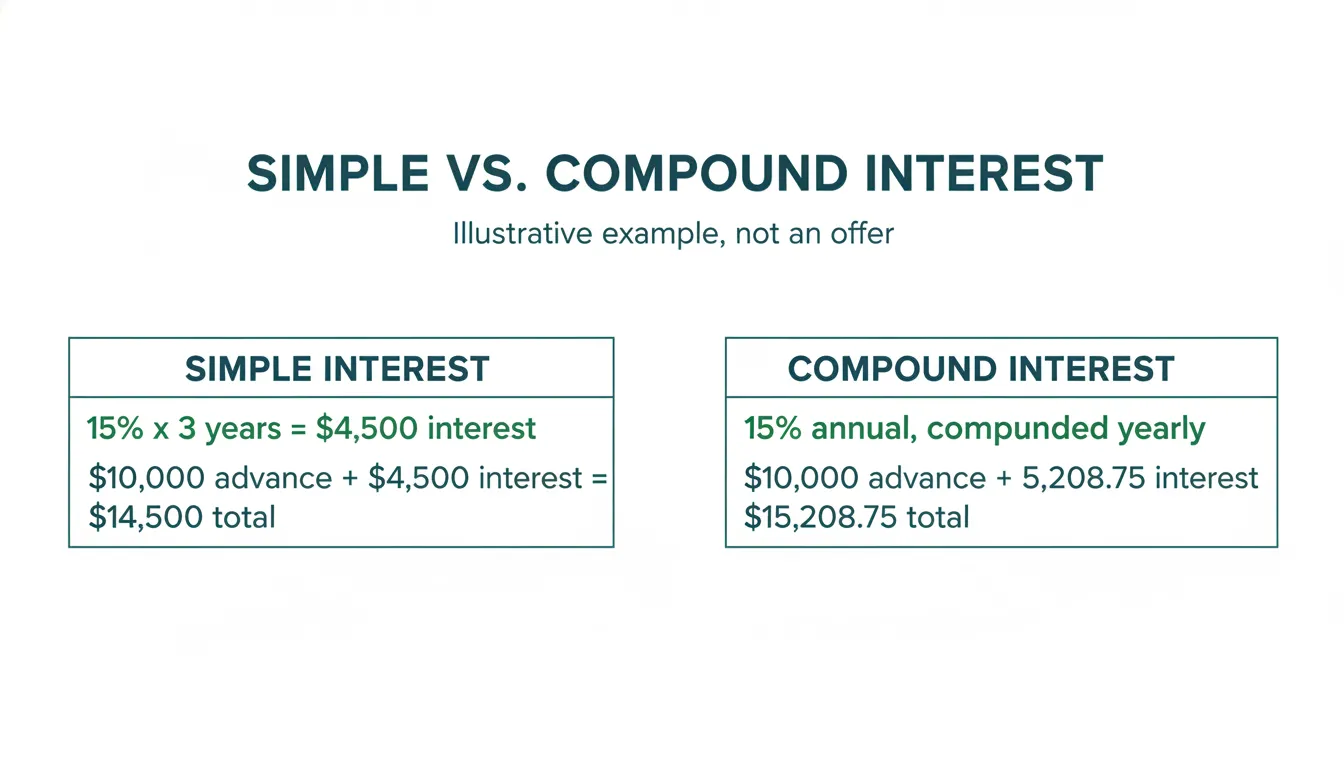
For illustration only, suppose an agreement advanced $10,000 and charged 15% annual interest for three years, with no fees or payments. At simple interest, the interest would be $4,500, producing a total of $14,500. If the same nominal annual rate compounded once each year, the balance would be about $15,208.75. This example is only a way to see the difference in the arithmetic. It is not a quote, prediction, or representation of any offer. Actual terms may calculate charges differently, and the agreement controls.

When you review an offer, ask in plain language:

  • Is interest simple or compound, and when does accrual begin?
  • How often is interest calculated or added to the balance?
  • Are there fees at the start, during the case, or at repayment?
  • Does a cap limit the total payoff, and how is that cap applied?
  • Can additional advances or amendments change the balance?

Request payoff estimates in dollars at several possible resolution dates. The figures should specify the amount you would receive, charges, and assumptions used for each estimate. A balance at six months may look very different from one at two years. Make sure you compare estimates prepared on the same timeline and with the same amount advanced.

The Office of the Comptroller of the Currency publishes interest rate risk statistics reports based on examinations of banks it supervises. Those reports concern banks, not consumer lawsuit advances, and do not establish the terms of any funding agreement. They are a reminder that interest-rate exposure is analyzed in financial contexts; for an individual plaintiff, the relevant figures are the calculation method and payoff estimates in the written contract.

Illustrative comparison of simple and compound interest on a $10,000 advance over three years.

What should you check before accepting an offer?

Use the agreement and written payoff estimates as your source of truth. Before signing, separate what you receive now from what may be repaid later. A concise checklist can keep important terms from getting lost in a long document:

  1. Confirm the net amount. Identify the amount delivered to you and whether any fee is deducted before payment.
  2. Find the repayment trigger. Confirm whether payment is tied to a recovery, what counts as a recovery, and how the funder is paid.
  3. Understand no-recovery language. Read the part addressing a lost, dismissed, or otherwise unsuccessful case. Check whether any exceptions or conditions apply.
  4. Trace every charge. Note the rate, simple or compound method, accrual frequency, and any fees or minimums.
  5. Ask for multiple payoff figures. Request estimates for reasonable timeframes and the assumptions behind them.
  6. Check for a cap and changes. Understand any repayment limit and how future advances, amendments, or case events affect it.
  7. Review timing and cancellation terms. Ask whether early payoff is allowed and how it would be calculated.
  8. Take time for attorney review. Ask counsel how the agreement could affect case proceeds and whether the information-sharing process raises concerns.

Compare offers using the same assumed advance and resolution dates. Put the net cash, payoff at each date, fees, cap, and no-recovery terms next to one another. Do not compare one provider’s annual rate with another provider’s total dollar payoff as if they were the same measure. If a provider will not explain its calculation or provide clear written terms, pause before agreeing.

It can also help to write down the specific expense the advance is meant to address and when it is due. Then compare that need with the amount you would receive and the possible reduction in proceeds later. This is not a forecast of the case result. It is a way to make the tradeoff concrete and consider whether other options or waiting might be preferable.

Why does the attorney participate?

A funder may need information about the claim, its status, and the expected path to resolution to evaluate a request. With the plaintiff’s authorization, the attorney may answer questions or provide case information. The precise process varies. Before authorizing disclosures, ask what information is requested, who will receive it, and how it will be used.

The attorney’s involvement does not make the attorney the borrower or transfer control of the lawsuit to the funder. The plaintiff and counsel remain responsible for decisions about the case, including whether to accept a settlement. Do not assume the funder has authority over legal strategy. Ask your attorney to explain any contract term that could affect the case or the distribution of proceeds. The Foundation’s information for attorneys describes its attorney-facing resources, while its overview of advance requirements discusses information that may be relevant to an application.

Attorneys can help identify case-specific concerns and explain how repayment might fit into the resolution process. They cannot make the funding decision for the plaintiff. Give counsel enough time to review the complete agreement, not only a summary or a proposed payoff number.

How does The Milestone Foundation describe its funding?

The Milestone Foundation is a 501(c)(3) nonprofit organization and consumer litigation funding company. It describes its model as mission-focused and offers pre-settlement and post-settlement advances. The Foundation states that its advances use simple interest and that total repayment is subject to a 2X cap; the written agreement for a particular transaction sets the applicable terms. Ask for a dollar payoff illustration and confirm exactly how any cap applies before making a decision.

A nonprofit structure does not remove the need to read a contract, compare costs, or consider whether an advance suits your circumstances. It also does not guarantee that a particular request will be approved or that a case will resolve in a certain way. Review the Foundation’s background and nonprofit mission alongside the terms offered for your case. The fair pre-settlement funding guide offers further information about the organization’s approach.

How can you compare total repayment step by step?

Use one worksheet for each offer. The goal is not to predict the settlement or decide whether an advance is right for someone else. The goal is to understand the possible dollars and conditions on the same basis.

  1. Write down the amount you would actually receive after any deductions.
  2. Record every charge and how it is calculated.
  3. Mark whether interest is simple or compound and its accrual schedule.
  4. Ask for written payoff totals at several time points, such as six months, one year, and two years, when appropriate.
  5. Note the cap, early-payoff terms, and any conditions that could change the figures.
  6. Read the no-recovery provision and record what the agreement says happens if there are no proceeds.
  7. Review the worksheet and agreement with your attorney before signing.

For example, if two offers provide the same net amount, put each provider’s estimated payoff at one year and two years in adjacent columns. Add a separate note for how a case loss is treated. That comparison may show that a lower initial charge is not the only relevant difference, or that the same-looking rate produces different outcomes because of compounding, fees, or a cap. If the estimates use different assumptions, ask each provider to recalculate them on matching assumptions rather than guessing.

If you would like to ask the Foundation how its application and review process works, you can use its plaintiff funding information. A request for information is not a commitment to sign; take time to review the terms and consult your attorney.

Contact the Foundation with a question

What should plaintiffs remember about lawsuit funding?

What happens if my case loses?

Check the written agreement rather than relying on the phrase “non-recourse.” Find the clause about no recovery and confirm whether it addresses dismissal, an unsuccessful outcome, or other circumstances. Ask the funder to explain any exception, and ask your attorney to review it. The protection depends on the contract’s actual wording.

Will an advance reduce what I keep from a settlement?

If repayment is due under the agreement, it is generally paid from proceeds, which can reduce the amount left for you. To understand the possible effect, compare a range of hypothetical recovery amounts with the projected payoff and any other obligations that may apply. These examples cannot predict the result of a case. Your attorney can help explain case-specific issues.

Is a lawsuit advance right for every plaintiff?

No. Consider the immediate need, the amount you would receive, the possible payoff over time, and other options that may be available. If there is no urgent need, waiting or exploring alternatives may be worth discussing with counsel. If you consider an advance, review the complete agreement, request estimates in writing, and make your own decision after understanding the tradeoffs.

What is the bottom line?

“Lawsuit loan” is a broad everyday phrase, not a complete description of a financial product. Focus on the written terms: whether repayment depends on a recovery, what happens if there is no recovery, how interest and fees accumulate, and what the payoff could be at different points in time. Compare offers on the same assumptions, involve your attorney, and make sure you understand the agreement before signing.

Back to All Posts
November 2, 2026

Can I Get Pre-Settlement Funding Without My Attorney’s Consent?

Can I get pre-settlement funding without my attorney’s consent? You may be able to contact a provider or begin an inquiry on your own, but that does not mean an application can be responsibly evaluated or completed without your attorney’s participation. Case facts, procedural status, and the possibility and timing of a recovery matter to a review. Your attorney can help explain those facts and how an advance could affect your case and potential recovery.

Ask about funding options

Consent can mean permission to inquire, cooperation with a case review, acknowledgment of an agreement, or direction about repayment from a recovery. Those are different steps. Provider practices, contract terms, and legal requirements can vary. Do not assume that a provider’s willingness to speak with you means attorney involvement is unnecessary. This is general information, not legal advice about your case.

Can I Get Pre-Settlement Funding Without My Attorney’s Consent?

There is no single answer for every provider or lawsuit. Some providers may let a plaintiff make an initial inquiry without formal attorney approval. Annuity.org’s discussion of pre-settlement funding without attorney consent likewise explains that a plaintiff may seek funding without consent, while many providers want a lawyer involved. The practical difference is between starting a conversation and completing a review and transaction.

A provider assessing a case needs reliable information about the claim, its procedural stage, liability and damages issues, and the possibility and timing of a recovery. Much of that information is held by counsel or is best explained by counsel. A provider may ask your attorney to confirm representation and case details, provide or review information, acknowledge paperwork, or coordinate repayment from a recovery. Without that cooperation, a review may pause or the provider may be unable to proceed.

Ask the provider: “What attorney participation do you require, and at what stage?” Request a written explanation. If you receive an offer, discuss it with your attorney before signing or agreeing to repayment. A preliminary inquiry is not the same as approval, and approval is not the same as accepting an agreement.

Also distinguish a provider’s intake rules from rules that may apply to a particular transaction. A provider may accept contact details directly but still require counsel’s confirmation before making an offer or completing the process. Case type, jurisdiction, and contract language can matter. Another plaintiff’s experience does not determine what applies to your case.

For example, submitting a form to learn what information is needed may only open a conversation. A later step could involve a request to verify that an attorney represents you, review case records, or acknowledge an agreement. Ask whether the first step creates any obligation, authorizes the release of information, or simply allows the provider to contact you. Do not infer the answer from the word “application”; read the actual form and ask about unclear language.

Why does attorney participation matter?

Your attorney knows the case and the legal work needed to move it forward. A funder is not a substitute for counsel and should not make litigation-strategy decisions. Attorney participation can help ensure case information is accurate, the proposed arrangement is understood, and the transaction does not interfere with legal work or the attorney-client relationship.

Counsel can also help set realistic expectations. A claim may involve disputed facts, motions, negotiations, appeals, or delays. Even when a case appears strong, no one can promise a particular result or date. The provider evaluates the matter under its own process; the attorney remains responsible for legal advice and representation.

Coordination can clarify the amount advanced, repayment terms, and the way proceeds may be distributed if the case resolves. It gives counsel a chance to identify questions before the client commits. It can also help avoid treating an estimated settlement as money already available to spend. The provider may use its own underwriting criteria, but only counsel can advise the client about the legal case and the client’s choices within it.

Consider a plaintiff who has received a proposed amount while negotiations are still underway. The number on an offer sheet does not establish what the plaintiff will ultimately receive. Counsel may need to explain unresolved issues, anticipated case expenses, other claims on proceeds, and the uncertainty of timing. These details matter when weighing the value of funds now against an obligation tied to a future recovery. The example does not predict any individual case; it shows why case-specific context belongs in the discussion.

What does attorney consent look like in practice?

Consent may not be one signature or conversation. Depending on the process, counsel may be asked to verify representation, confirm basic case details, supply requested records, review an agreement, or acknowledge how repayment would be handled from a recovery. Ask what action is requested, whether it is mandatory, and whether counsel is being asked to advise, verify information, or accept a specific term.

Make the conversation concrete. Share the provider’s name, the amount you are considering, the complete written terms, and any stated deadline. Tell your attorney whether you made an inquiry or received an offer. You can ask the provider to contact counsel directly if that is preferred, while confirming what information would be shared. If you have received only a preliminary estimate, label it as such instead of presenting it as a final offer.

Read any form before signing. It may authorize sharing information, direct proceeds, state repayment obligations, or create another commitment. Do not sign a document simply because someone calls it routine. If a provision is unclear, pause and ask your attorney to explain it. Keep copies of the form, the agreement, and any written explanation so that everyone can refer to the same language.

A practical sequence is to first ask the provider what the inquiry authorizes, then tell your lawyer you are exploring an option, and then share the complete paperwork before accepting terms. If the provider needs a response by a particular date, give counsel the actual date and ask whether more time is available. Avoid compressing the review into a sales call or relying on a verbal description when a written agreement is available.

What should your attorney review?

Attorney review is more than a procedural box. It helps place the proposal in the context of the case and the client’s interests. Depending on the agreement, discuss:

  • Case information: Is the provider’s understanding of the claim and current status accurate? Which facts remain uncertain, and what information is still being investigated?
  • Amount and need: Is the requested amount tied to a specific need? Would a smaller amount or waiting be a reasonable alternative? A request should be considered in light of what the client needs and what the agreement could require later.
  • Repayment formula: What would be owed, when could it be due, and what happens if there is no recovery? Ask for the actual contract language and written examples rather than relying only on a brief summary.
  • Net recovery: How might repayment interact with attorney fees, case costs, liens, or other obligations? The order and amounts depend on the case and agreement. Ask counsel to explain which items are known and which remain uncertain.
  • Control and communication: Does the arrangement preserve the client’s decision-making and the attorney’s independent judgment? Counsel should consider terms that could affect settlement advice or case work.
  • Information sharing: What records or case details will be shared, with whom, and under what terms? Clarify what authorizations cover and whether the client can ask questions about them.
  • Timing and changes: Does the repayment illustration change if the matter resolves later than expected? What happens if the case posture changes or there is no recovery? The written terms, not an assumption, should answer this.

These are discussion points, not universal legal requirements. Terms differ by provider. Attorneys can review information for attorneys about nonprofit litigation funding as one resource. A plaintiff should still ask their own lawyer for case-specific advice rather than treating a general resource as a substitute for counsel.

Attorney reviewing a case file and funding paperwork

One useful method is to ask counsel to walk through the agreement in sections: the amount provided, the event that triggers repayment, the calculation method, any cap or limit described, and what happens if the case ends without recovery. Then compare the explanation with the exact clause. If the provider’s summary and the agreement seem inconsistent, ask for clarification before signing rather than guessing which statement controls.

Why do fiduciary considerations matter?

Attorneys have professional duties to clients. Counsel should give advice guided by the client’s interests, explain material risks, and maintain independent judgment. A funding arrangement should not pressure a lawyer to recommend a settlement, alter legal strategy for a funder’s benefit, or treat a possible recovery as guaranteed.

The client decides whether to seek funding and whether to accept a settlement after receiving legal advice. A funder does not replace the lawyer, and the lawyer does not promise a result. The discussion should give the client room to weigh immediate needs against possible repayment from a future recovery.

For a plaintiff, this means asking for a plain explanation of the agreement and its effect under different timelines. For counsel, it means reviewing the terms and explaining practical consequences. If a proposed term appears to limit the attorney’s ability to advise or control the case, ask counsel to explain the concern before moving forward. A careful review is not a guarantee that an application will be accepted or that the case will resolve in a particular way.

Attorney participation also helps keep roles clear. The provider can explain its application requirements and contract; counsel can provide legal advice about the claim and the client’s interests; the client can decide whether to proceed after understanding both. If any participant appears to be asking the attorney to endorse a case outcome or give up independent judgment, stop and discuss the language with counsel. The client should not feel required to accept a particular settlement because funding is being considered.

How does non-recourse funding differ from a conventional loan?

A conventional personal loan generally creates repayment obligations under its contract whether or not a separate legal claim succeeds. Non-recourse case-related funding is tied to a specified recovery: under the agreement, repayment comes from that recovery, and if the case produces no recovery, the plaintiff owes nothing. Read the agreement carefully; details and legal treatment depend on its terms and applicable law.

The Milestone Foundation is a 501(c)(3) nonprofit consumer litigation funding company. It describes its plaintiff funding as non-recourse, meaning a plaintiff owes nothing if the case is lost. Nonprofit status does not remove the need to review an agreement or mean every application will be accepted. Read about nonprofit litigation funding and the organization’s funding FAQs.

The comparison below is general. Compare the actual agreement offered to you, not only the product label. Repayment language and applicable requirements can vary.

Question Conventional personal loan Non-recourse case-related advance
What is repayment tied to? Repayment is generally required under the loan contract. Repayment is tied to a recovery as stated in the agreement.
What if there is no recovery? The borrower may still owe under the loan terms. Under a non-recourse arrangement, the plaintiff generally owes nothing if the case produces no recovery, subject to the agreement.
What information is reviewed? The lender’s process may consider the borrower’s financial information. The legal claim and its status are central; the provider may request attorney participation.
Who controls case strategy? Case strategy is not generally part of an ordinary personal loan. The plaintiff and attorney retain responsibility for case decisions.

The label alone does not show the full financial effect. Check how the agreement calculates repayment, what event triggers payment, and whether the amount changes over time. If it describes a cap, charge, or other limit, locate the exact clause and ask how it works. Do not rely on one sample figure if the case might take longer or resolve differently.

A useful comparison is a written illustration under more than one timeline. Ask the provider to state its assumptions, then ask counsel to consider those amounts alongside expected fees, costs, liens, and other obligations. A projected settlement is not the same as the amount a plaintiff ultimately receives. Neither a projection nor an illustration promises a case result or date.

For instance, compare the agreement’s stated calculation at an earlier resolution date with its calculation at a later one, if the provider supplies those examples. Note whether the amount is fixed or changes according to a stated formula. Then ask your attorney which assumptions are uncertain and how the repayment would fit with the distribution of proceeds. This is a way to understand the terms, not a forecast of when a case will resolve.

Keep the agreement and written explanations. If an explanation conflicts with the contract, ask which language controls and resolve the discrepancy before signing. Consider whether the immediate need justifies the possible reduction in future proceeds.

What can you do if your attorney is hesitant?

Ask what the concern is. Counsel may need to review repayment language, understand information requests, or consider the effect on the case and the client’s recovery. A pause may mean there are unanswered questions; it is not necessarily a refusal to help.

  1. Ask for the specific concern. Is it the agreement, cost structure, confidentiality, timing, settlement effect, or another issue? Ask whether counsel needs a particular clause or document to assess it.
  2. Provide the complete terms. Share the proposed agreement and disclosures, not just a sales summary. Include any forms authorizing case-information sharing and any written repayment illustration.
  3. Clarify the requested attorney role. Ask the provider whether counsel must confirm case details, acknowledge terms, or take another step. Find out whether each step is required to proceed or is simply part of a request.
  4. Discuss alternatives. Ask whether a smaller advance, different timing, or another source of support might reduce the effect on a future recovery. Do not assume one option is best without comparing the actual terms and circumstances.
  5. Take time to decide. Do not sign under pressure. Confirm whether an inquiry creates any commitment and whether you can decide later.

If counsel will not participate, ask whether the concern is specific to one agreement or to funding generally. You may seek another legal opinion if appropriate, but do not conceal the application or share case information against your attorney’s advice. A provider’s willingness to discuss an inquiry without counsel does not show that a particular contract suits you. If your attorney explains a concern, ask for the specific term or case issue behind it so you can understand the reason and consider your options.

It can help to separate factual questions from the decision itself. For example, you might first ask the provider what documents and attorney actions it requires, without authorizing a transaction. Then ask counsel to review the actual documents. Once the unanswered questions are addressed, you can decide whether to continue, seek a different arrangement, or stop. You do not need to treat an inquiry as a commitment unless the written terms say otherwise; verify that point before proceeding.

What questions should you ask before moving forward?

Use clear questions to get useful answers from both counsel and the provider. Bring the answers together rather than evaluating the provider’s process and the legal effect in isolation:

  • Is this inquiry only, or does submitting it authorize anything?
  • What information from my attorney is needed, and why?
  • Does my attorney need to verify representation, provide information, review an agreement, or acknowledge a repayment direction?
  • What would repayment look like under different timelines, using the agreement’s actual calculation?
  • What happens if the claim does not produce a recovery?
  • Are there charges or terms beyond the amount and formula described to me?
  • How might an advance affect what I receive after other obligations?
  • Can I take the agreement to my attorney and decide later?
  • Can the provider explain its answers in writing, and who can answer questions about legal consequences?

Ask for answers in writing when possible. The Foundation’s plaintiff funding page describes its application information, and its lawsuit advance requirements page offers additional context. These materials do not replace advice from your attorney. They can help you identify what to ask, while counsel can address how the documents relate to your particular claim.

What is the next step?

You may be able to ask about pre-settlement funding without your attorney’s formal consent, but completing a responsible case review commonly depends on attorney cooperation. Counsel can help verify case information, explain uncertainty, and review how repayment could affect a potential recovery. Bring the full written terms to your attorney and decide only after you understand them.

Review plaintiff funding information

Attorney participation is not merely a formality; it helps put a proposed advance in the context of your case, legal advice, and financial needs.

Back to All Posts

Explore More

Learn More About The Milestone Foundation