Blog

June 11, 2026

The Essential Guide to Lawsuit Pre Settlement Funding

Let’s clear up the biggest misconception right away: lawsuit pre settlement funding is not a loan. With a loan, you have to pay it back no matter what, and your personal assets could be at risk. This is different. Funding is a non-recourse advance, which means repayment is tied only to the outcome of your case. If you win, the advance is repaid from the settlement. If you don’t win your case, you owe nothing. This structure removes the risk of taking on new debt, providing a financial safety net that allows you to pursue justice without fear of personal financial loss.

Apply for Funding Attorneys: Refer a Client Learn About Us / Our Mission

Key Takeaways

  • It’s an advance, not a loan: Pre-settlement funding is non-recourse, meaning repayment is tied only to your case. You pay back the advance from your settlement if you win, and you owe nothing if you lose.
  • Prioritize simple interest and transparency: The difference between simple and compounding interest is huge, so always choose a funder who offers clear, simple rates. A trustworthy partner will be upfront about all costs, with no hidden fees to surprise you later.
  • Partner with your attorney: You must have a lawyer to apply for funding, and they are your most important guide. Your attorney will help you vet funders, manage the application, and ensure the financial support aligns with your legal strategy.

What Is Lawsuit Pre-Settlement Funding?

Lawsuit pre-settlement funding, often called a lawsuit advance, is a financial option that provides plaintiffs with money before their case is resolved. Think of it as an advance on the money you expect to receive from your settlement. It’s designed to help you cover urgent living expenses, medical bills, and other costs while your attorney works to get you the best possible outcome. This isn’t a loan. Instead, pre-settlement funding is an advance against your future settlement. This distinction is crucial, and it’s what makes this type of funding a unique option for plaintiffs who are feeling financial pressure.

The goal is to provide financial stability, allowing you and your attorney the time needed to secure a fair resolution rather than accepting a lowball offer out of desperation. It helps level the playing field against well-funded defendants and their insurance companies. By easing your financial burdens, you can focus on your recovery and your case.

How Is It Different From a Loan?

The biggest difference between pre-settlement funding and a loan is how it’s repaid. With a traditional loan, you have to pay it back, period. With pre-settlement funding, repayment depends entirely on the outcome of your case. The funding company is making an investment in your potential settlement. If you win your case, the advance is repaid from the settlement funds. But if you lose, you owe nothing. This structure removes the burden of debt if your case isn’t successful, which is a major point of relief for many plaintiffs who are considering pre-settlement funding companies.

What Does “Non-Recourse” Mean?

You’ll hear the term “non-recourse” a lot when discussing lawsuit funding, and it’s the key to why this isn’t a loan. Non-recourse means the funding is secured only by your lawsuit. Your personal assets, your car, your house, and your future income are completely off-limits. The only thing the funding company has a claim to is a portion of the settlement, and only if you win. This funding is low-risk because it’s non-recourse. If you lose your case, you are not required to pay back the funding. This is the fundamental promise of ethical pre-settlement funding.

How Does Pre-Settlement Funding Work?

Getting pre-settlement funding might seem complicated, but it’s a straightforward process designed to get you financial support quickly. It all happens in partnership with your attorney, ensuring your case stays on track while you get the breathing room you need. The process is transparent and moves quickly, so you can focus on your recovery instead of your finances. Here’s a look at the five simple steps from application to repayment.

Step 1: Partner With Your Attorney

The entire process begins with the relationship you have with your attorney. Before you can apply for funding, you must have a lawyer representing you in your personal injury case. This is a non-negotiable first step because funding companies work directly with law firms to understand the details of a lawsuit. Your attorney provides the necessary documentation and insight for the funder to review your case. This partnership ensures that everyone is aligned and that the funding supports your legal strategy without interfering with it. For us, collaborating with attorneys is the foundation of providing responsible and ethical support to their clients.

Step 2: Apply for Funding

Once you and your attorney decide that funding is the right move, the next step is to apply. We’ve made our application process as simple as possible because we know you’re already dealing with enough stress. You can typically complete the form online in just a few minutes. You’ll provide some basic information about yourself and your case, and then we take it from there. The most important thing to remember is that your attorney must be involved. You can apply for funding directly on our website, and we will coordinate with your legal team to handle the rest.

Step 3: The Funder Reviews Your Case

After you submit your application, the funding company gets to work. This step involves a careful and confidential review of your case. We will contact your attorney to gather relevant documents and discuss the merits of your lawsuit. This isn’t about judging you or your situation; it’s about understanding the potential for a successful outcome. Based on this review, the funder determines if you are eligible and calculates the amount of funding you can receive. The goal is to provide a financial bridge that makes sense for your specific case without putting undue pressure on your future settlement.

Step 4: Receive Your Funds

Waiting for money is stressful, which is why the funding process is built for speed. Once your application is approved, the funds are sent directly to your bank account, often within 24 hours. This rapid turnaround means you can get immediate relief for urgent financial needs, whether it’s covering rent, paying for medical treatments, or handling daily living expenses. You don’t have to wait for your lawsuit to resolve to regain some financial stability. The funds are yours to use for whatever you need most while your attorney continues to fight for the full value of your case.

Step 5: Repay Only if You Win

This is the most important feature of pre-settlement funding: you only repay the advance if you win your case. Because the funding is non-recourse, all the risk is on the funder, not you. If your case is successful, the advance, plus our simple interest, is paid back directly from the settlement or award. If you do not win your case, you owe nothing. This structure is central to our nonprofit mission, as it ensures you can pursue justice without fearing personal financial loss. It’s a safety net that allows you to move forward with confidence.

Who Qualifies for Pre-Settlement Funding?

If you’re a plaintiff in the middle of a personal injury case, you might be wondering if pre-settlement funding is an option for you. The good news is that the qualification process is more straightforward than a traditional loan. Funders are less concerned with your personal financial history and more focused on the details of your legal claim. This approach makes financial support accessible when you need it most. Let’s walk through the key factors that determine eligibility.

What Types of Cases Qualify?

Pre-settlement funding is designed for plaintiffs with strong personal injury claims. While every case is unique, funders typically work with clients involved in situations like:

  • Car, truck, and motorcycle accidents
  • Medical malpractice
  • Nursing home abuse
  • Premises liability (injuries on someone else’s property)
  • Wrongful death
  • Defective products
  • Employment law cases

The common element in all these cases is a verifiable injury and a strong legal claim against a defendant. If you have a solid case with clear liability, there’s a good chance you will qualify for funding. The funder’s goal is to assess the likelihood of a successful settlement or verdict. You can see if your case is a fit when you apply for funding.

Does Your Credit Score Matter?

In short, no. Your credit score and financial history do not play a role in whether you qualify for pre-settlement funding. Unlike a bank loan, this type of funding is not based on your ability to repay from your personal finances. Instead, the decision rests entirely on the merits of your lawsuit. Funders are looking at the strength of your case, not your credit report. This is a critical feature of non-recourse funding, as it ensures a plaintiff’s past financial struggles don’t prevent them from getting the support they need while their case proceeds. This plaintiff-first approach is central to our nonprofit mission.

Why Your Attorney’s Involvement Is Key

You cannot get pre-settlement funding without an attorney, and for good reason. Your attorney is the crucial link between you, your case, and the funding company. They provide the necessary documentation and professional assessment of your claim that allows the funder to make an informed decision. This partnership ensures the funder has a clear picture of the case’s strengths and potential value. Furthermore, your attorney manages the repayment process directly from the settlement proceeds if you win. This collaboration is essential for a smooth and ethical funding experience, which is why we work so closely with attorneys to support their clients.

How Can Pre-Settlement Funding Help You?

When you’re in the middle of a lawsuit, life doesn’t just press pause. Bills keep arriving, and the financial strain can feel overwhelming, especially if an injury has left you unable to work. Pre-settlement funding is designed to provide a financial safety net, giving you access to a portion of your expected settlement funds now, when you need them most.

This isn’t just about getting by; it’s about regaining control. By easing the immediate financial pressure, funding allows you and your attorney to focus on the most important thing: winning the fair compensation you deserve. It provides the stability needed to see your case through without making desperate financial decisions along the way. Let’s look at the specific ways this support can make a difference.

Cover Medical Bills and Treatment

After an injury, your top priority should be your health. However, medical bills can pile up quickly, creating a new source of stress. Pre-settlement funding provides immediate cash that you can use to pay for doctor’s visits, physical therapy, prescription medications, and other essential treatments. This ensures you don’t have to delay or skip necessary care due to cost. Having access to these funds gives you the freedom to focus on your recovery without the added weight of financial worry, which is a critical part of the healing process.

Replace Lost Wages

If your injury has forced you to take time off work or left you unable to earn an income, the financial impact can be devastating. Pre-settlement funding helps bridge this gap by replacing lost wages. This advance on your future settlement can help you cover your mortgage or rent, car payments, and other recurring bills that don’t stop even when your paycheck does. It provides the stability your family needs to stay afloat while you wait for your case to resolve, ensuring that a temporary inability to work doesn’t turn into a long-term financial crisis.

Avoid Pressure to Settle for Less

Insurance companies and defense attorneys are often aware of the financial pressure plaintiffs face. They may use delaying tactics, hoping you’ll become desperate enough to accept a settlement offer that is far less than what you deserve. Pre-settlement funding gives you staying power. By covering your expenses, it removes the urgent need for a quick payout, allowing your attorney to negotiate from a position of strength. You won’t feel forced to accept a lowball offer just because you need money quickly, which empowers you to hold out for the fair outcome your case warrants.

Manage Daily Living Expenses

Beyond major expenses like medical bills and housing, it’s the daily costs that can add up and break a budget. Pre-settlement funding can be used to manage these everyday living expenses, from groceries and utilities to childcare and transportation. When a lawsuit is taking a long time, this financial support can help you pay for your living costs and other immediate needs. It’s about maintaining a sense of normalcy for you and your family during a challenging period. If you are struggling to cover these costs, you can apply for funding to get the support you need.

What Does Pre-Settlement Funding Cost?

When your client is considering pre-settlement funding, cost is understandably a top concern. The total price of the advance isn’t just a single number; it’s a combination of the interest rate, how that interest is calculated, and any additional fees. Because this is a non-recourse advance on a potential settlement, not a traditional loan, the cost structure works differently. The funder takes on the risk, so if you don’t win the case, your client owes nothing. This risk is factored into the price, but it shouldn’t come at the expense of your client’s financial future.

The goal is to find funding that provides immediate relief without consuming the bulk of the eventual settlement. A transparent funder will be upfront about every aspect of the cost, ensuring there are no surprises when the case resolves. Understanding these components is the first step for any attorney looking to vet a funding partner and protect their client’s best interests. Before your client signs any agreement, it’s crucial to have a complete picture of what they will owe upon a successful settlement. This means looking beyond a headline interest rate and digging into the contract to understand the full financial picture. A good funding partner makes this process easy, not difficult.

Simple vs. Compound Interest: What’s the Difference?

The difference between simple and compound interest can have a massive impact on the total amount your client repays. Simple interest is calculated only on the original amount of the advance (the principal). For example, if your client receives a $10,000 advance with simple interest, the interest is always calculated based on that initial $10,000. It’s straightforward and predictable.

Compound interest, on the other hand, is calculated on the principal plus any interest that has already accrued. This means your client pays interest on the interest, causing the total amount owed to grow much faster, especially in a lawsuit that takes years to resolve. The Milestone Foundation is a nonprofit that provides fair and transparent financial advances using only simple interest, so the cost remains clear and manageable from day one.

How Are Rates Calculated?

Pre-settlement funding companies are essentially investing in the outcome of your client’s case. The interest rate they offer is based on their assessment of the case’s risk. Funders will review the details of the lawsuit, including the strength of the legal claim, the estimated timeline for resolution, and the potential settlement value. A case with clear liability and significant damages may receive a lower rate than one with more uncertainty.

Because the funding is non-recourse, the funder assumes all the risk. If the case is lost, they lose their entire investment. This is why rates for pre-settlement funding are typically higher than those for a standard loan, where the borrower’s assets serve as collateral. It’s important to compare quotes and contract terms from different funders to ensure your client receives a fair rate for their specific situation.

Watch Out for Hidden Fees

A low interest rate can be misleading if the contract is loaded with hidden fees. Some for-profit funders tack on extra charges that can dramatically inflate the total repayment amount. These can include application fees, processing or underwriting fees, and even delivery fees just to send the funds. These costs are often buried in the fine print of the agreement, making it difficult to see the true cost of the advance.

As an attorney, it’s vital to help your client scrutinize any funding contract before they sign. Ask the funder directly if there are any fees beyond the principal and interest. A trustworthy partner will provide a clear, all-inclusive rate with no surprises. At Milestone, we work directly with attorneys to ensure complete transparency, with no hidden fees to worry about. What you see is what you get.

The Pros and Cons of Pre-Settlement Funding

Pre-settlement funding can be a lifeline for plaintiffs, but it’s a financial decision that deserves careful thought. Like any tool, it has clear benefits and potential drawbacks. Understanding both sides helps you and your attorney decide if it’s the right move for your situation. The goal is to find support that empowers you, not a solution that creates new problems down the road. Let’s walk through the key advantages and disadvantages to consider.

Pros

When you’re injured and out of work, waiting for a settlement can feel impossible. The most immediate benefit of pre-settlement funding is financial relief. It provides the money needed to cover urgent costs like medical bills, rent, and daily living expenses. This stability can bring incredible peace of mind, allowing you to focus on your recovery instead of constantly worrying about finances. This financial cushion also gives your legal team a stronger negotiating position. When you aren’t desperate for cash, you won’t feel pressured to accept the first lowball offer an insurance company throws your way. Your attorney gains the time needed to fight for the full and fair compensation you deserve. Best of all, this is a low-risk option for plaintiffs. Because funding is non-recourse, you only repay the advance if you win your case. If you lose, you owe nothing.

Cons

The biggest downside of pre-settlement funding is the potential cost, especially when dealing with for-profit lenders. Many companies charge high, compounding interest rates and tack on hidden fees that can quickly eat into your final settlement. This is why it’s so important to read the fine print and understand exactly how much you will owe. Some plaintiffs end up surprised by the final amount, which can be a significant portion of their award. Other concerns often stem from misunderstandings about how funding works. Some plaintiffs worry that a funder will try to control their legal case, but a reputable company will never interfere with your attorney’s decisions. It’s also common to confuse funding with a traditional loan, but it’s actually an advance against your future settlement. When you apply for funding, the focus is on the strength of your case, not your personal credit history. Choosing the right partner is key to avoiding these pitfalls.

Common Myths About Pre-Settlement Funding

Pre-settlement funding can be a lifeline for plaintiffs, but it’s also surrounded by a lot of confusion and misinformation. For attorneys, separating fact from fiction is critical when advising a client who is struggling financially while their case is pending. When your client is unable to work or is facing mounting medical bills, the pressure to accept a lowball settlement offer can be immense. Funding provides the breathing room they need to see their case through to a fair resolution.

Unfortunately, predatory practices in the for-profit funding industry have created some persistent myths that can make both attorneys and plaintiffs hesitant. It’s important to understand that not all funders operate the same way. A mission-driven, nonprofit funder offers a completely different experience than a company focused on maximizing its returns. Let’s clear up some of the most common myths so you can make an informed decision that protects your client’s best interests and the integrity of their case.

Myth: It’s Just Another Loan

This is probably the most common and most important myth to bust. Pre-settlement funding is not a loan; it’s a non-recourse advance on a potential settlement. The key difference is risk. With a traditional loan, you have to pay it back no matter what, often with your personal assets on the line. A non-recourse advance is different. If your client loses their case, they owe nothing. The funding is repaid only from the proceeds of a successful settlement or verdict. This structure transfers the financial risk from the plaintiff to the funding company, providing a true safety net without creating new debt.

Myth: The Funder Controls Your Case

Many attorneys worry that accepting outside funding will mean giving up control over legal strategy. This is a valid concern, but it’s unfounded when you work with a reputable funder. Ethical funding companies have no involvement in or influence over the legal proceedings. Your professional judgment and your client’s decisions remain the driving force behind the case. At Milestone, we partner directly with attorneys but our role is strictly financial. We are a passive resource, here to support your client so you can focus on achieving the best possible outcome without interference. The attorney-client relationship is always paramount.

Myth: You Need Good Credit to Qualify

When a person is injured and out of work, their credit score is often the last thing on their mind, and it may even take a hit. Thankfully, personal credit history has no bearing on qualifying for pre-settlement funding. Unlike a bank, we aren’t evaluating an individual’s creditworthiness. Instead, the decision to provide funding is based entirely on the merits of the legal case itself. We review the case details with you to assess its strength and the likelihood of a successful outcome. This means your client can apply for funding with confidence, regardless of their credit score or financial history.

Myth: The Fees Are Always Sky-High

It’s true that some for-profit funders charge exorbitant, compounding interest rates that can eat away at a plaintiff’s settlement. This is why it’s so important to look closely at the terms. However, high fees are not a universal rule. As a nonprofit, The Milestone Foundation was created to be a fair alternative. We charge a flat 15% simple interest rate, which never compounds. This transparent and straightforward approach ensures that the costs are predictable and manageable. By understanding the difference between simple and compound interest, you can help your client avoid predatory terms and keep more of their hard-won settlement.

How to Choose the Right Funder

Finding the right funding partner is just as important as securing the funds themselves. The pre-settlement funding industry is filled with a wide range of companies, and their terms, rates, and business models can vary dramatically. For an attorney, recommending a funder to your client is a significant responsibility. The wrong choice can lead to predatory terms that eat away at a client’s settlement and create more financial distress down the road. The right partner, however, acts as a true ally, providing a fair and ethical financial bridge that allows you to fight for the full value of the case.

Choosing a funder requires careful diligence. It’s about looking beyond the promise of fast cash and examining the fine print. You need a partner who is transparent, operates with integrity, and puts the plaintiff’s well-being first. By evaluating potential funders based on their fee structures, business models, and processes, you can protect your client and ensure the funding serves its intended purpose: providing stability without sacrificing the future. The following points will walk you through exactly what to look for to make a confident and responsible choice.

Look for Transparent Rates and Fees

A trustworthy funder will always be upfront about their costs. When you’re vetting a company, look for one that clearly outlines its rates and fees without hiding details in complex legal jargon. You and your client should know exactly what to expect from day one. The funding agreement should explicitly state the interest rate and, crucially, whether it is simple or compounding. Be wary of companies that are vague about their fee structures or add on unexpected “application” or “processing” fees after the fact. True transparency means the funder provides a clear, easy-to-understand contract that empowers your client to make an informed financial decision, not one that confuses them.

Consider Nonprofit vs. For-Profit Funders

The funder’s business model has a direct impact on your client. Most pre-settlement funding companies are for-profit, meaning their primary goal is to generate returns for their investors. This profit motive often leads to high, compounding interest rates that can quickly diminish a plaintiff’s final settlement. In contrast, nonprofit funders like The Milestone Foundation operate on a completely different model. As a mission-driven organization, our goal is to provide a fair and protective service to plaintiffs. We offer more favorable terms not to maximize profit, but to help people cover essential needs while their case is ongoing, preventing them from falling victim to exploitative financial practices.

Confirm It’s Truly Non-Recourse

One of the most critical features of pre-settlement funding is that it must be non-recourse. This is the defining characteristic that separates it from a traditional loan. Non-recourse means that if you and your client lose the case, the advanced funds do not have to be repaid. The funder assumes all the risk. Before your client signs any agreement, you must confirm that this principle is clearly stated in the contract. Any company that suggests the advance must be repaid regardless of the case outcome is not offering true pre-settlement funding and should be avoided. This protection is non-negotiable and ensures your client isn’t saddled with debt from a lost legal battle.

Understand the Approval Process

When a client needs funding, they often need it quickly. That’s why a funder’s approval process is so important. A reputable company will have a straightforward and efficient system that respects both your time and your client’s urgent situation. The process should be clear from the start, with the funder explaining exactly what case documents are needed for their review. Look for a partner who communicates well and works collaboratively with you to gather information without causing unnecessary delays. A complicated or slow process only adds more stress to an already difficult time. You can apply for funding with us through a simple, streamlined process designed for attorneys.

Ask These Questions Before You Sign

Before your client accepts a funding offer, it’s essential to ask some critical questions to ensure there are no surprises later. Think of it as a final due diligence checklist. Start with the most important question: Is the interest simple or compounding? Ask for a clear breakdown of all fees, including any that might be charged upfront or at closing. It’s also wise to request a payoff schedule showing what the total repayment amount would be at different time intervals, such as six months, one year, and two years. Finally, ask what happens if the settlement amount is less than the total owed. A trustworthy funder will have clear and fair answers to all these questions.

Why Milestone Is a Different Kind of Funder

The Milestone Foundation was created to be a better kind of funder. We saw how for-profit companies were trapping plaintiffs in cycles of debt with compounding interest and hidden fees, and we knew there had to be a more ethical way. As a nonprofit, our mission guides everything we do. We offer fair, transparent advances with a 15% simple interest rate that never compounds. This approach allows your clients to cover their immediate needs without having to sacrifice their future financial stability. When you partner with Milestone, you’re choosing an organization that aligns with your duty to your client, ensuring they get the support they need on terms that are fair and just.

How to Apply for Pre-Settlement Funding

Once you and your attorney decide that pre-settlement funding is the right move, the application process should be straightforward. Reputable funders have refined their process to be as simple as possible for you and your legal team. The goal is to get a clear picture of your case so they can make a fair decision, not to bury you in paperwork. Your attorney will handle most of the communication, so you can stay focused on your recovery.

The entire process is built on the partnership between you, your attorney, and the funding company. The funder relies on your attorney’s expertise to understand the merits of your case, and your attorney ensures your interests are protected every step of the way. At Milestone, we’ve designed our process to be transparent and efficient. You can begin your application for funding in just a few minutes, and from there, we work directly with your lawyer to gather what we need. To get started on the right foot, there are a few key things you can do to prepare.

Gather Your Case Documents

To speed up the review, it helps to have your case documents organized and ready. While your attorney will manage the submission, being prepared shows the funder that your case is well-documented and actively progressing. This documentation gives the funding company a clear and comprehensive view of your claim’s strengths.

Key documents often include the initial complaint filed with the court, relevant police or incident reports, major medical records and bills, and proof of lost wages. Having these materials accessible allows your attorney to quickly respond to the funder’s request for information. A streamlined application process means a faster decision, helping you get the financial support you need without unnecessary delays.

Work Closely With Your Attorney

You must have an attorney representing you to receive pre-settlement funding. This is a critical requirement from any ethical funder because it protects you. Your attorney is your most important partner in this process. They can offer the best perspective on whether funding is a good option for your specific situation and will handle the application for you. Reputable funders work directly with law firms, which is why we have a dedicated portal for attorneys.

Your lawyer will communicate the details of your case, provide the necessary documents, and act as the main point of contact with the funding company. This arrangement ensures that all information is accurate and that the terms of the funding agreement are clear and fair.

Be Honest on Your Application

Transparency is essential when applying for pre-settlement funding. The funding company evaluates your case to determine the likelihood of a successful outcome, as this is how they assess their risk in a non-recourse arrangement. Being honest about the details of your case, both the strengths and potential weaknesses, is crucial.

Withholding information or exaggerating facts can slow down the process and may even lead to a denial. A strong application is an honest one. Your attorney will help present the facts in a clear and compelling way, but it all starts with the truthful information you provide them. This honesty builds a foundation of trust and allows the funder to make a fair and informed decision.

Is Lawsuit Pre-Settlement Funding Right for You?

Deciding whether to take pre-settlement funding is a significant choice, and there’s no single right answer. It all comes down to your personal situation. The time between filing a lawsuit and receiving a settlement can be long and filled with financial uncertainty. If you’re struggling to cover living expenses or medical bills, the pressure to accept a quick, low offer from the defense can be immense. Pre-settlement funding is designed to relieve that pressure, giving your attorney the time they need to fight for the full value of your case.

The first step is to have an honest conversation with yourself and your family about your financial needs. Are you at risk of missing rent payments or falling behind on bills? Are you putting off necessary medical care because of the cost? If the financial strain is compromising your well-being, funding could be a lifeline. It’s also crucial to remember that this is an advance, not free money. The amount you receive, plus interest and any fees, will be deducted from your final settlement. You need to weigh the immediate benefit against the reduced payout later.

Ultimately, this is a decision you should make in close partnership with your attorney. They can help you understand the terms of any funding agreement and determine if it aligns with the strategy for your case. Your lawyer’s involvement is essential, as they will be responsible for repaying the funder directly from the settlement proceeds if you win. By working together, you can make an informed choice that supports both your immediate needs and your long-term legal goals. Because Milestone is a nonprofit, we work directly with attorneys to provide fair, transparent funding that puts your client’s best interests first.

Apply for Funding Attorneys: Refer a Client Learn About Us / Our Mission

Frequently Asked Questions

How much money can I actually get? The amount of funding you can receive depends on the specifics of your case. A funder will review the details with your attorney, including the strength of your claim and the estimated value of your potential settlement. Responsible funders typically offer an advance that is a percentage of the expected outcome, usually around 10 to 15 percent. This approach ensures you get the help you need without taking on an advance so large that it consumes your entire settlement later.

What happens if my settlement is smaller than the amount I owe the funder? This is an important question and a key reason to choose an ethical funding partner. With a reputable funder, you will never owe more than what you receive in your settlement. If the final award is less than the repayment amount, the funder reduces what you owe. You should never be left with nothing or, even worse, in debt from the funding. This protection should be clearly stated in your agreement.

Can I get additional funding later if my case takes longer than expected? Yes, in many situations, you can apply for a second advance if your case is prolonged and you need more financial support. The process is similar to your initial application. The funder will reconnect with your attorney to get an update on your case and re-evaluate your financial need. As long as your case remains strong, obtaining additional funds is often possible to help you stay afloat until your case resolves.

Why is working with a nonprofit funder so different? A funder’s business model directly impacts the service you receive. For-profit companies are designed to make money for investors, which can lead to high, compounding interest rates and hidden fees that maximize their return. A nonprofit funder, like The Milestone Foundation, has a mission to help plaintiffs, not to generate profit. This means we can offer fair terms, like simple interest that never compounds, because our priority is your financial stability.

Does taking on funding affect my attorney’s control over the case? Absolutely not. A reputable funder acts as a silent financial partner and has no say in your legal strategy. Your attorney remains in complete control of all decisions related to your case, from negotiation tactics to whether or not to accept a settlement offer. The funding company’s role is simply to provide you with the financial resources you need, not to interfere with the attorney-client relationship in any way.


Back to All Posts
June 4, 2026

The Litigation Funding Crisis No One Is Talking About

By Rachel McCarthy of The Milestone Foundation and Jeremy Alters of ClaimAngel

For plaintiffs navigating the civil justice system, time is rarely on their side.

An accident or tragedy can upend every part of a person’s life at once. Medical bills accumulate, rent is always due, and living expenses do not pause simply because someone may be hurt and out of work. Yet litigation often can take months or years to resolve, and that financial pressure can force plaintiffs into impossible choices: accept an unfair settlement now or keep waiting for a more just outcome while their situation grows more precarious.

In many cases, the only option available is litigation financing — cash advances protected by a future settlement. But what most plaintiffs don’t realize when they sign up is how costly that lifeline can be. Funders often hide behind the defense that they are taking on high risks, given that the funding is “non-recourse,” thus plaintiffs bear no responsibility to pay back if they lose. In reality, annual percentage rates in this market can start around 36% and climb as high as 200%, far exceeding virtually any conventional borrowing option. Compounding interest, opaque contract terms, and complex repayment structures mean that even when plaintiffs win, a significant share of their settlement will be diverted to funding companies — not because they lost, but because staying in the fight required borrowing on terms that were never fully explained to them.

This is a civil justice problem hiding inside a financial one.

A Market Built on Opacity

The consumer litigation funding industry did not set out to harm plaintiffs. At its best, it exists to solve a real and serious problem: injured people need financial support while their cases move forward, insurance companies deliberately delay and the legal system moves slowly. Without some form of bridge financing, many legitimate claims never reach resolution. Plaintiffs are forced to settle for far less than they deserve or abandon their cases entirely.

But good intentions and good outcomes are not the same thing. And for far too long, the litigation funding market has operated without the transparency, standardization, or accountability that plaintiffs deserve.

In most of the market, pricing is not disclosed upfront clearly and transparently. Rates compound in ways that are difficult for non-experts to calculate or anticipate. Contracts are written to benefit funders, not borrowers. And because plaintiffs typically arrive at funding companies at moments of acute financial stress — after an accident, a medical crisis, or the sudden loss of income — they are not in a position to negotiate, comparison shop, or fully evaluate what they are agreeing to.

The result is a marketplace where the most vulnerable participants consistently get the worst terms. Where financial desperation, rather than the merits of a case, can determine how much of a settlement a plaintiff actually keeps. And where the very tool that was meant to help plaintiffs pursue justice can end up undermining the value of the justice they achieve.

The Problem Goes Deeper Than Bad Actors

It would be convenient if the solution were simply to identify and remove predatory lenders. But the structural issues in consumer litigation funding go beyond any single company or practice.

The market as a whole lacks consistent pricing standards. There are no industry-wide ethics framework governing how funders interact with plaintiffs. Attorneys who want to send clients to funding sources face their own ethical gray areas, with limited guidance on what constitutes responsible advocacy versus arrangements that cross the line.

Many plaintiffs don’t even realize the full impact of these arrangements until they receive their settlement and see how much they owe. In this way, the funding industry can be just as harmful as a situation where plaintiffs have no access to funding at all.

The absence of standards doesn’t just harm plaintiffs directly. It also distorts the broader litigation environment. An ethical litigation system cannot function this way. One’s existing financial situation should never determine whether someone can fully pursue justice.

What Ethical Funding Actually Looks Like

There are organizations working to change this and demonstrate that a better model is possible.

At The Milestone Foundation, our work is rooted in a simple premise: financial hardship should never prevent someone from fully pursuing justice. As the nation’s only nonprofit consumer litigation funding provider, we were founded in 2016 specifically to fill the gap left by a predatory market — to offer plaintiffs suffering catastrophic harm a funding option that does not exploit the very vulnerability that brought them to us.

In practice, that means rates that are simple interest, never compounding — 15% for pre-settlement funding and 10% for post-settlement funding. It means advances designed to cover essential living expenses: housing, food, transportation, utilities. It means funding that is always non-recourse — if a case does not resolve, the plaintiff owes nothing. Since our founding, we have provided more than $7 million in nonprofit funding to over 1,000 plaintiffs, in partnership with more than 330 law firms nationwide.

But alas, a nonprofit model alone cannot reform an entire market.

The Milestone Foundation strategically allied with ClaimAngel because they take a different but complementary approach. As a tech-enabled marketplace, ClaimAngel brings standardization and transparency to the plaintiff funding space — requiring every funder on its platform to operate at a disclosed 27.8% simple annual rate with a two-time repayment cap. ClaimAngel’s platform has funded over $125 million in cases and over 25,000 fundings. Rather than replacing the market, it restructures it: using competition, compliance guardrails, and price visibility to push to create fair funding that allows the maximum recovery for plaintiffs.

What both models share — and what the broader market too often lacks — is a commitment to clarity, predictability, and the plaintiff’s long-term well-being.

The Litigation Funding Space Does Not Need One Ethical Option. It Needs an Ethical Ecosystem

No single organization, nonprofit or commercial, can reform a market on its own. What the consumer litigation funding space needs is not one good actor, but a shift in what the entire space considers normal.

That means pricing that is disclosed in plain terms before a plaintiff signs anything. It means interest structures that do not compound in ways that obscure the true cost of borrowing, rate caps and repayment limits that protect plaintiffs from runaway debt, and attorneys who can recommend funding sources without ethical ambiguity. Most importantly, it means a culture within the industry that treats plaintiffs as people seeking justice, not as assets to be monetized.

None of this is radical. It is simply what a functioning, ethical market looks like, and it is what the litigation funding space has not yet fully become.

The Milestone Foundation and ClaimAngel are working toward this standard and are proof that it is achievable. What remains is for the broader market to follow, and for plaintiffs, attorneys, and advocates to demand nothing less.

A plaintiff should never have to choose between financial survival and justice. The system that claims to serve them should be built accordingly.

Back to All Posts
June 1, 2026

The Hidden Cost of Compounding Interest in Lawsuit Loans 

=== FULL CONTENT ===

By: Julia Saunders 

When someone is injured and unable to work, financial pressure can build quickly. Medical bills pile up, household expenses don’t stop, and the legal process can take months to resolve. In these moments, many plaintiffs turn to lawsuit loans or pre-settlement funding to help cover essential expenses while their case is pending. 

A personal injury lawsuit typically takes 12 to 18 months to resolve. Straightforward cases (like a minor car accident) can settle in 3 to 9 months, while complex litigation (like medical malpractice or product liability) can take 2 to 3 years or more. [1, 2] The timeline is dictated by the specific phase of the legal process and several unique case factors. [1, 2] 

What many people don’t realize is that not all funding is created equally. 

One of the biggest hidden dangers in the lawsuit funding industry is compounding interest. 

What Is Compounding Interest? 

Compounding interest means that interest is charged not only on the original amount borrowed, but also on the accumulated interest over time. In other words, the balance continues to grow on itself month after month. 

While compounding interest is common in credit cards and some traditional loans, it can become especially harmful in the pre-settlement funding industry because legal cases are unpredictable in length. If a case takes longer than expected, the amount owed can increase dramatically. 

For example, someone who receives a $5,000 advance may end up owing significantly more by the time their case settles due to continuously compounding fees and interest. 

Unfortunately, many plaintiffs do not fully understand how quickly these costs can escalate until it is too late. 

Why It Matters 

Most people seeking lawsuit funding are already facing financial hardship. They often deal with lost wages, medical treatment, transportation challenges, and everyday living expenses after an injury. 

When compounding interest rapidly increases repayment amounts, it can reduce the plaintiff’s final recovery and add even more stress during an already difficult time. 

If you or your client is struggling with these costs, explore fair pre-settlement funding options with a nonprofit provider. Transparency matters. So does fairness. 

That is why it is important for plaintiffs and attorneys to ask questions before agreeing to any funding arrangement, including: 

  • Is the interest simple or compounding? 
  • How frequently does interest accrue? 
  • Are there additional fees? 
  • What could the total repayment amount look like over time? 

Understanding these details can make a significant difference in the outcome.  A judge gavel

The Simple-Interest Alternative: How The Milestone Foundation Is Different

Simple interest means interest is calculated only on the original advance amount — never on accumulated interest. For plaintiffs and attorneys evaluating funding options, this is the single most important structural difference to understand. While for-profit funders profit from compounding that makes balances grow exponentially, The Milestone Foundation’s nonprofit model lets us offer transparent, simple-interest funding that stays predictable.

How simple interest works: If you receive a $5,000 advance at 15% simple annual interest, the interest each year is $750 ($5,000 × 0.15). After two years, total interest is $1,500 — and the balance stops growing at that point. With compounding interest at a typical 3% monthly rate, the same $5,000 would accrue interest on interest, potentially reaching over $10,000 by month 24.

Our Pricing — Clear and Simple

  • Pre-settlement funding: 15% simple annual interest — never compounds
  • Post-settlement funding: 10% simple annual interest — never compounds
  • Non-recourse: You owe nothing if your case does not settle
  • No hidden fees: What you see is what you pay
Term For-Profit Funder (Compounding) The Milestone Foundation (Simple)
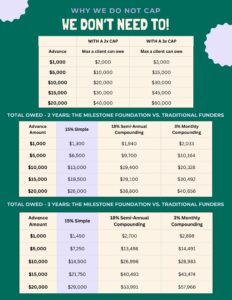
$5,000 advanced for 12 months ~$7,160 (3% monthly compound) $5,750 (15% simple annual)
$5,000 advanced for 24 months ~$10,255 (3% monthly compound) $6,500 (15% simple annual)
Interest structure Compounds monthly Simple, never compounds
Hidden fees Common None
Risk to plaintiff Balance snowballs if case is delayed Predictable, capped

For attorneys, recommending a funding source with simple interest helps fulfill your fiduciary duty to clients. It ensures the funding arrangement doesn’t undermine the settlement you work so hard to secure. Our Partners for Justice membership program gives law firms a straightforward way to connect clients with ethical, non-recourse funding at transparent rates.

Apply for funding today and experience the difference that nonprofit, simple-interest funding makes.

Empowering Plaintiffs Through Education 

The lawsuit funding industry can be confusing, especially for someone already under stress. That is why education is so important. 

Before signing any agreement, plaintiffs should carefully review the terms, ask questions, and understand how repayment works. Attorneys can also play an important role in helping clients evaluate funding options responsibly. 

Financial support can be a lifeline when used thoughtfully, but the structure of that support matters. 

At The Milestone Foundation, we are committed to doing things differently: with transparency, compassion, and fairness at the center of everything we do. 

Back to All Posts
May 12, 2026

Three Problems with the Traditional Consumer Litigation Funding Industry

By: Rachel McCarthy

The consumer litigation funding industry was built around a legitimate need: helping plaintiffs stay financially afloat while waiting for their cases to resolve. In theory, that support can level the playing field. In practice, however, many traditional funding companies have created a system that often prioritizes volume and profit over transparency and fairness. 

At The Milestone Foundation, we believe plaintiffs deserve clarity, fairness, and ethical treatment throughout the funding process. Here are three major issues we see with the traditional consumer litigation funding model. 

  1. Different Plaintiffs Receive Different Rates from the Same Funding Company

One of the least discussed problems in the industry is the way pricing can vary depending on the law firm involved and the funding company’s policies. 

Many traditional litigation funding companies offer preferential interest rates or terms to firms that send them a high volume of cases or maintain long-standing business relationships. A plaintiff represented by a “preferred” law firm may receive significantly better terms than another plaintiff with a nearly identical case simply because their attorney does not generate as much business for the funding company, or they might be a lesser-known attorney.  

That creates a troubling imbalance. 

The cost of funding should be determined by objective factors tied to the case itself — not by backroom business relationships or referral volume. Plaintiffs are the ones ultimately repaying the funding, yet they often have no visibility into whether they are receiving competitive or equitable terms. 

In any industry that serves vulnerable consumers, consistency and fairness matter. Litigation funding should be no exception. 

  1. Ambiguous Fees, Unnecessary Charges, Compounding costs

Another major issue is the lack of transparency surrounding fees and compounding costs. 

Many plaintiffs enter into funding agreements believing they understand the terms, only to discover additional servicing fees, processing fees, administrative charges, or recurring “case maintenance” fees buried in the contract. These costs can accumulate quickly over time and dramatically increase the repayment amount. 

Modern litigation funding operations are overwhelmingly digital. Documents are transmitted electronically. Status updates are often automated. Payment systems are streamlined. The operational cost of maintaining a file today is dramatically lower than it was a decade ago. 

So why are plaintiffs still being charged recurring servicing fees every six months? 

For many consumers, these fees feel less like legitimate operational necessities and more like mechanisms designed to maximize returns. This is on top of already egregious interest rates that compound monthly, quarterly, or bi-annually, and usually not in clear terms.  

Plaintiffs deserve straightforward pricing that clearly explains what they are paying for and why. Transparency should not be optional when someone is already navigating the financial and emotional stress of litigation. 

  1. Aggressive Marketing to Plaintiffs Encourages Dependency Instead of Restraint

Litigation funding can serve an important purpose in the right circumstances. But it should be treated as a last resort — not a product aggressively pushed onto vulnerable individuals. 

Unfortunately, many traditional funding companies market directly to plaintiffs with relentless persistence. Advertisements, targeted outreach, and repeated solicitations often frame funding as an easy solution rather than a serious financial decision with long-term consequences. 

Some companies go even further, encouraging potential plaintiffs to view litigation funding as part of the normal litigation process from the very beginning. 

That approach is deeply concerning. 

Most plaintiffs are already dealing with financial pressure, medical treatment, uncertainty, and stress. Presenting funding as quick and effortless can incentivize borrowing before it is truly necessary. In some cases, plaintiffs may take advances they could have avoided entirely with better guidance or financial planning. 

Responsible funding providers should educate plaintiffs, not pressure them. They should encourage restraint, transparency, and informed decision-making — even when that means a consumer chooses not to take funding at all. 

A Better Standard for Litigation Funding 

Consumer litigation funding is not inherently harmful. When structured ethically, it can provide meaningful support to plaintiffs who genuinely need temporary financial relief. 

But the industry must evolve. 

Fair and consistent pricing, transparent fee structures, and responsible consumer practices should be the baseline — not the exception. 

Plaintiffs deserve a funding process built around their interests, not one driven primarily by referral relationships, hidden fees, or aggressive marketing tactics. 


Back to All Posts
May 8, 2026

Plaintiff Litigation Funding: Questions Attorneys Should Ask

By Julia Saunders & Rachel McCarthy

As plaintiff litigation funding becomes more widely used, attorneys are increasingly searching for how to evaluate, compare, and responsibly recommend funding options for their clients.

But the most valuable searches aren’t basic definitions. They are deeper due diligence questions. Questions like: Which litigation funding companies are trustworthy? What are the risks of lawsuit funding? When should I recommend pre-settlement funding to a client?

The answers to these questions can directly impact your client’s financial outcome and your case strategy. Join our Partners for Justice membership program to access transparent, ethical funding options for your clients.

At The Milestone Foundation, we believe pre-settlement funding should be transparent, ethical, and aligned with access to justice. Below are six essential questions attorneys should be asking when evaluating plaintiff litigation funding providers.

How Do I Know if a Litigation Funding Company Is Trustworthy?

A trustworthy litigation funding company provides clear, upfront disclosure of all fees and repayment terms, uses simple interest rather than compounding, and maintains open communication with both attorney and client. Look for transparent contracts that are easy to explain to your client.

Attorneys frequently search “how to choose a litigation funding company” or “best pre-settlement funding companies for attorneys.” The answer starts with transparency.

A trustworthy plaintiff funding company should provide:

  • Clear, upfront disclosure of all fees and repayment terms
  • Simple, easy to understand contracts with no hidden language
  • Straightforward explanations of total repayment scenarios
  • Open communication with both attorney and client

If the terms are difficult to explain, they are likely difficult for your client to understand, and that is a risk. Many plaintiff funding companies intentionally use confusing language so plaintiffs do not fully understand the harm that they may be signing up for. Attorneys have a fiduciary duty to their clients. Recommending a funder with opaque terms can expose both the client and the law practice to unnecessary risk and potential malpractice exposure. The safest approach is to evaluate each funding agreement as if you would have to defend its terms in front of a judge or ethics board.

The Milestone Foundation prioritizes full transparency at every step, ensuring attorneys can confidently review and explain funding terms without concern. Explore transparent, ethical funding options through our attorney membership program.

What Are the Biggest Red Flags in Pre-Settlement Funding Agreements?

The biggest red flags include compounding interest structures that grow rapidly over time, excessive or unclear fees, no clear cap on total repayment, and contracts that obscure the true cost of funding. If the terms are difficult to explain, that is a risk.

Search terms like “lawsuit funding risks” and “predatory litigation funding terms” are increasingly common among attorneys, and for good reason. The for-profit funding industry has grown rapidly, and with that growth has come a wide range of contract practices.

Key red flags include:

  • Compounding interest structures that grow rapidly over time
  • Excessive or unclear fees that inflate repayment amounts
  • No clear cap on what the plaintiff may ultimately owe
  • Contracts that obscure the true cost of funding

These structures can significantly reduce a plaintiff’s net recovery. For example, a $5,000 advance at 5% monthly compounding can grow to over $8,000 in just 12 months. Even a modest-looking monthly rate can produce an annual percentage rate exceeding 60%, a burden that few plaintiffs anticipate when they sign the agreement. By contrast, the same $5,000 advance at The Milestone Foundation’s 15% simple annual rate would add just $750 in interest over 12 months for a total of $5,750. This difference matters enormously for plaintiffs whose cases take one, two, or even three years to resolve, and it is exactly the kind of comparison that attorneys should be making when evaluating funding partners for their clients.

The Milestone Foundation eliminates these risks by offering straightforward terms and simple, non-compounding interest rates designed to protect plaintiff and attorney outcomes. We cap total repayment at 2x the advance amount, giving plaintiffs and their attorneys certainty about the maximum obligation from day one.

Will Pre-Settlement Funding Affect My Case Strategy or Settlement Timeline?

Reputable litigation funding companies have zero control over case strategy, never influence or pressure settlement decisions, and respect the attorney’s role as the sole legal advisor. Funding should never interfere with your professional judgment.

One of the most common concerns attorneys research is whether litigation funding interferes with legal decision-making or creates pressure to settle. The answer depends entirely on the funder’s business model and contract structure.

A reputable pre-settlement funding company should:

  • Have zero control over litigation strategy
  • Never influence or pressure settlement decisions
  • Respect the attorney’s role as sole legal advisor

Funding should relieve pressure, not create it. Because The Milestone Foundation’s funding is non-recourse, the plaintiff owes nothing if the case is lost. This means the funding company has no incentive to push for a premature settlement. The risk stays with the funder, not the client or the attorney. Ethical funding can actually strengthen the attorney-client relationship by removing financial desperation from the settlement equation entirely.

The Milestone Foundation operates with a strict non-interference model, ensuring attorneys retain full control while clients gain financial stability.

When Should I Recommend Pre-Settlement Funding to My Client?

Pre-settlement funding is worth recommending when a client faces genuine financial hardship such as difficulty paying rent or mortgage, lack of transportation, or pressure to accept an unfair settlement due to economic need. It helps level the playing field.

Attorneys often wonder exactly when and whether pre-settlement funding is appropriate for their clients. They do not want to approve funding if it will end up hurting their clients in the long run due to high interest rates or hidden fees. But in many situations, pre-settlement funding is a necessary and beneficial option for a plaintiff facing genuine need. The key is finding a funding partner whose terms are fair enough that the benefit of financial relief today clearly outweighs the cost of repayment from the settlement proceeds.

Pre-settlement funding should be considered when a client is facing real financial hardship, such as:

  • Difficulty paying rent or mortgage and facing eviction or foreclosure
  • Medical bills piling up from the injury at the center of the case
  • Lack of transportation to attend court dates, medical appointments, or depositions
  • Inability to cover groceries and basic living expenses for themselves or their family
  • Mounting utility bills or debt that threatens the household’s financial stability
  • Pressure from creditors that could force an early, unfavorable settlement decision

In these situations, funding can help level the playing field. It allows clients to pursue fair case outcomes without financial desperation driving their decisions. When a plaintiff can afford to wait for a just settlement rather than accepting whatever settlement offer comes first, the entire case benefits. The attorney can focus on maximizing the case value rather than managing the client’s financial crisis.

Learn how fair and transparent pre-settlement funding supports better outcomes for both attorneys and their clients. The Milestone Foundation exists to support clients in exactly these scenarios, providing relief that protects both the client and the case.

How Can I Tell if a Lawsuit Funding Company Will Take Advantage of My Client?

Watch for companies that use vague or overly complex contracts, high-cost structures that are not clearly disclosed, compounding interest rates disguised as simple rates, and pressure tactics that bypass the attorney. The best protection is a transparent, nonprofit funding partner.

Queries like “is this lawsuit funding company legit” or “how to avoid predatory pre-settlement funding” highlight a major concern for attorneys evaluating funding partners.

Warning signs include:

  • Vague or overly complex contracts that bury key terms in fine print
  • High-cost structures that are not clearly disclosed upfront to the attorney or client
  • Lack of attorney involvement or transparency about how the company works with counsel
  • Difficulty getting clear answers to simple questions about interest, fees, and repayment terms
  • Emphasis on how quickly funds will be released rather than the fairness of the terms
  • Aggressive marketing directly to plaintiffs without requiring attorney participation

A simple rule: if you cannot quickly and clearly explain the terms to your client, that is a red flag. The for-profit funding model relies on complexity and opacity. The less the plaintiff understands about compounding rates and hidden fees, the more profitable the arrangement becomes for the funder. As an attorney, your ability to evaluate these terms is your client’s first and best line of defense against predatory lending practices. When reviewing a funding agreement, ask yourself whether you could explain every single term to your client in plain language in under five minutes. If the answer is no, that funding arrangement deserves much closer scrutiny.

The Milestone Foundation takes a different approach, offering clear agreements, transparent pricing, and direct collaboration with attorneys to ensure clients are fully protected at every stage of the process.

Are There Alternatives to Traditional Litigation Funding Companies?

Yes. The Milestone Foundation is the country’s only nonprofit plaintiff funding company, offering fair, transparent funding at 15% simple annual interest with no hidden fees and a 2x cap on total repayment. Nonprofit and marketplace alternatives provide ethical options beyond traditional for-profit funders.

Attorneys frequently search for “low-cost pre-settlement funding companies” hoping to find a provider that will not exploit their clients. Unfortunately, many traditional funders operate on essentially the same model. They use compounding interest, hidden fees, and opaque contracts that grow the repayment obligation far beyond what the plaintiff originally expected or agreed to.

There are two alternatives that are not driven by profit and are designed to offer a better experience for plaintiffs and their attorneys:

  • The Milestone Foundation is the country’s only non-profit plaintiff funding company. It was built to provide a fair, transparent alternative to traditional high-cost funding models. With pre-settlement funding at 15% simple annual interest and post-settlement funding at 10% simple interest, plus a guaranteed 2x cap on total repayment, the numbers are predictable and fair from day one. Our nonprofit model means every dollar above operating costs goes back into expanding access to justice, not to shareholders or executive compensation.
  • ClaimAngel is a marketplace platform that brings together traditional funding companies to offer a standardized rate. While still operating within the for-profit ecosystem, the marketplace model can increase price transparency for plaintiffs who have the time and knowledge to compare options.

For attorneys who want the most cost-effective and transparent option for their clients, The Milestone Foundation’s 15% simple annual interest structure means the total repayment grows at a steady, predictable rate. It never compounds and it never surprises. Attorneys can confidently explain to their client exactly what the maximum repayment will be on day one, with no fine print and no hidden fees. For a case that takes 18 months to reach settlement, a $10,000 advance at simple interest costs $2,250 in total interest. The same advance from a for-profit funder at a 5% monthly compounding rate could cost over $12,000 in interest alone.

Conclusion

The rise of plaintiff litigation funding has created both opportunity and risk for the legal profession. For attorneys, the key is not simply finding funding. The key is finding a funding partner that puts their client’s best interest first, offers transparent terms that are easy to evaluate and explain, and operates with a mission that aligns with the attorney’s own ethical obligations and fiduciary duties.

By asking smarter questions about transparency, risk, timing, and ethics, attorneys can better protect their clients and strengthen case outcomes. Whether you are evaluating a funder for the first time or reassessing your current referral partners, these six questions provide a framework for meaningful due diligence that puts the client’s financial future at the center of every decision. Due diligence is not just a best practice. It is an essential part of fulfilling the attorney’s responsibility to recommend only those financial products and services that truly serve the client’s interests.

The Milestone Foundation is committed to setting a higher standard. We provide pre-settlement and post-settlement funding that supports plaintiffs without compromising their financial future.

Back to All Posts
April 22, 2026

When Auto Insurance Claims Go Unpaid: Why It Matters for Plaintiffs and Access to Justice 

By The Milestone Foundation Team 

At The Milestone Foundation, we work with many plaintiffs whose cases begin with a car accident. For them, the crash itself is only the beginning of the hardship. In the weeks and months that follow, they may be dealing with painful injuries, mounting medical bills, missed paychecks, transportation issues, and uncertainty about the future. 

That financial pressure becomes even heavier when insurance claims are delayed, denied, or underpaid. 

A recent report highlighting claim denials in the auto insurance industry has sparked an important conversation about fairness, transparency, and accountability. While every claim is different and some denials may be legitimate, the broader concern is one we see every day: when injured people cannot access timely support, families suffer. 

The Human Impact of Delayed or Denied Claims 

Behind every insurance claim is a real person trying to rebuild their life after an accident. 

When support is delayed or denied, plaintiffs may face impossible choices, such as: 

  • Paying rent or covering medical treatment  
  • Buying groceries or keeping up with utility bills  
  • Returning to work too soon before fully healing  
  • Taking on debt just to survive  
  • Losing stability during an already traumatic time  

For many, these are not hypothetical concerns—they are urgent realities. 

Why Financial Stability Matters During Litigation 

Personal injury cases often take time to resolve. Investigations, treatment, negotiations, and legal proceedings do not happen overnight. Yet bills continue to arrive while a case is pending. 

That gap between injury and resolution is where plaintiffs are most vulnerable. Without support, financial stress can become overwhelming and may even pressure injured people into accepting less than they deserve simply to make ends meet. 

How The Milestone Foundation Helps 

The Milestone Foundation was created to offer a better path. As the only nonprofit in the consumer litigation funding industry, our mission is rooted in one belief: plaintiff funding should be a resource and a benefit, not a harm. 

We provide low-cost financial assistance designed to help plaintiffs maintain stability while their cases move forward. Our goal is not to profit from hardship, but to provide dignity, relief, and hope during a difficult chapter. 

For plaintiffs recovering from car accidents, that support can help cover essential living expenses such as: 

  • Housing  
  • Utilities  
  • Groceries  
  • Transportation  
  • Everyday necessities  

Why Transparency and Consumer Protection Matter 

Conversations about insurance reform are ultimately conversations about people. Plaintiffs deserve a system that is fair, transparent, and responsive when they need help most. They deserve accountability from institutions that collect premiums and promise protection. 

Stronger consumer protections and greater transparency can help restore trust and ensure injured individuals are not left behind after an accident. 

Looking Ahead 

At The Milestone Foundation, we will continue standing with plaintiffs navigating financial hardship after car accidents and other serious injuries. Because access to justice is about more than the courtroom—it is also about whether someone can keep a roof overhead, put food on the table, and hold on long enough to see their case through. 

When claims go unpaid, the consequences are personal. That is why our work matters. 

Back to All Posts
April 20, 2026

The Rising Cost of Basic Living in America and What It Means for Access to Justice 

By Julia Saunders 

For many Americans, the idea of “basic living expenses” has shifted from a baseline of stability to a constant financial strain. 

Basic living expenses refer to the essential costs required to maintain a household and function day-to-day. These typically include housing, utilities, groceries, transportation, and healthcare—expenses that are not optional, but necessary for survival. 

Today, those costs are higher than ever. Recent data (including consumer financial insights from Intuit research) shows that the average American household spends approximately $6,000 per month or more on basic living expenses. In many cases, housing alone consumes 25% to 33% of household income, leaving little flexibility for emergencies or unexpected financial disruptions. 

What “Basic” Actually Costs Today 

Across the United States, essential monthly expenses commonly break down as follows: 

  • Housing (rent or mortgage, insurance, taxes): ~$2,000–$2,200/month  
  • Transportation (car payments, fuel, insurance, public transit): ~$1,000–$1,100/month  
  • Food (groceries and essentials): ~$660–$850/month  
  • Utilities (electricity, water, internet, gas, trash): ~$400–$750/month  
  • Healthcare (insurance, prescriptions, care): varies widely, often several hundred dollars monthly  

When combined, these necessities leave many households with little to no remaining income after covering the basics. And for families facing unexpected crises such as job loss, illness, or injury, the financial pressure can become immediate and overwhelming. 

The Hidden Financial Pressure Behind Legal Claims 

One of the most overlooked financial stressors comes when individuals are involved in legal claims that take months or even years to resolve. While a case moves through the legal system, daily life does not pause. Bills continue. Rent is due. Transportation is still required. Families still need food, childcare, and medical care. 

To illustrate this, in 2025, The Milestone Foundation reviewed the needs of plaintiffs it supported and found the following breakdown of financial pressure: 

  • Combination of multiple essential needs: 45%  
  • Housing costs: 34%  
  • Transportation: 14%  
  • Childcare: 6%  

These numbers highlight a critical reality: for many plaintiffs, financial strain is not caused by one expense, but by several overlapping necessities that become unmanageable at once. 

How Funding Can Support Stability During a Long Case

When a legal claim takes months or years to resolve, the same rising costs described above can create pressure for a plaintiff and family. Rent, utilities, groceries, transportation, childcare, and medical expenses continue while the case is pending. Access to justice can be harder to maintain when immediate financial needs push someone toward an early settlement decision.

For eligible plaintiffs, litigation funding can provide a non-recourse advance to help with essential living expenses while a case is pending. The Milestone Foundation offers pre-settlement advances at 15% simple interest, never compounding. For plaintiffs with an agreed settlement who are waiting for settlement funds, post-settlement funding is available at 10% simple interest, also never compounding. Both options are non-recourse, so repayment is not required if the plaintiff does not recover in the case.

The Milestone Foundation is a 501(c)(3) nonprofit company, and funding is subject to case details and attorney verification. These options are not a promise of approval or legal advice. Plaintiffs who want to explore whether funding may fit their situation can apply for funding, and the team will coordinate with their attorney.

Where The Milestone Foundation Fits In 

As a provider of low-interest pre-settlement funding, The Milestone Foundation helps plaintiffs maintain financial stability while their legal cases are pending. This support is designed to cover essential living costs, so individuals are not forced into financial desperation while waiting for fair resolution. By helping plaintiffs meet basic needs like housing, utilities, transportation, and childcare, the Foundation helps ensure that financial pressure does not dictate legal outcomes. Plaintiffs who want to learn more about whether this option may fit their situation can apply for funding through The Milestone Foundation. 

Access to Justice Includes Financial Stability 

Access to justice is often discussed in terms of legal rights, representation, and fair outcomes. But there is another layer that is just as important: the ability to survive financially while pursuing justice. When basic living costs consume nearly all household income, even a strong legal claim can become difficult to sustain. Financial instability can pressure individuals into settling early or accepting less than they deserve simply to meet immediate needs. Addressing this gap is central to The Milestone Foundation’s mission—ensuring that plaintiffs are not forced to choose between financial survival and fair legal recovery. 

The Bigger Picture 

Rising costs of living are not a temporary challenge—they reflect a broader economic reality affecting millions of households. As essential expenses continue to climb, more Americans find themselves living one unexpected event away from financial instability. Understanding this context is essential to understanding why financial support during litigation matters. Because access to justice doesn’t just happen in court—it happens at the kitchen table, at the rent due date, and in the everyday decisions families are forced to make while waiting for their cases to resolve. 


Back to All Posts
April 15, 2026

Why The Milestone Foundation Is a Nonprofit — And Why It Matters 

By Rachel McCarthy

At The Milestone Foundation, everything we do begins with a simple but powerful idea: plaintiff funding should be a resource and a benefit, not a harm, to plaintiffs. That belief is the reason we chose to be a nonprofit organization—and it continues to guide how we serve the legal community every day. 

What It Means to Be a Nonprofit 

The Milestone Foundation is a 501c3 public charity, incorporated in New York State. We are the only nonprofit in the consumer litigation funding industry.  

Being a nonprofit means that our organization exists to advance a mission rather than generate profits for owners or shareholders. Any funds we receive—whether through repaid advances, donations, grants, or partnerships—are reinvested directly into our programs, services, and initiatives. 

For The Milestone Foundation, this structure ensures that every dollar supports the people we care about most: plaintiffs. It creates accountability, transparency, and a deep sense of responsibility to the communities we serve. 

Why We Chose the Nonprofit Path 

The decision to become a nonprofit wasn’t just a legal or financial one—it was a reflection of         our values. 

We recognized early on that the consumer litigation funding industry is not plaintiff friendly. Traditional funding companies charge high interest rates that can leave a plaintiff depleted once they finally receive their settlement. The priority of the traditional pre-settlement funding industry is making money, not helping to keep plaintiffs stable while they go through litigation.  

But our origination was also designed as an experiment: can a nonprofit organization make it in the consumer litigation funding industry? Is it possible to provide plaintiff funding at low-cost? Is there an appetite for this among the civil justice community? Would trial lawyers show up and support this type of nonprofit?  

Ten years later, the answer to these questions is YES.  

The challenges we aim to address require long-term commitment, trust, and collaboration. A nonprofit model allows us to: 

  • Focus entirely on impact rather than revenue generation 
  • Build trust with donors, partners, plaintiffs, and the legal community 
  • Access funding opportunities like grants and charitable contributions 
  • Operate with transparency, ensuring stakeholders know how resources are used 

Most importantly, it keeps us aligned with our mission of fair funding. 

How the Nonprofit Model Works for Plaintiffs

The Milestone Foundation delivers fair pricing because its nonprofit structure changes the fundamental economics of litigation funding. Here is how the model works in practice — and why it consistently costs less.

The Recycled Capital Cycle

When a case settles, the plaintiff repays the advance plus the agreed simple interest. In a for-profit model, that repayment goes to investors and shareholders. At The Milestone Foundation, every dollar of repaid capital flows back into the fund to support new plaintiffs. This recycled capital model means the same pool of money can serve multiple plaintiffs over time, reducing the need to charge high rates to attract external investment.

Simple Interest, Not Compounding

Most for-profit funders charge interest that compounds monthly or quarterly. At a 5% monthly compounding rate, a $10,000 advance can grow to $17,958 in just 12 months. The Milestone Foundation charges 15% simple annual interest on pre-settlement funding. On that same $10,000 advance over 12 months, the total repayment is $11,500 — a savings of nearly $6,500. The interest never compounds, never accelerates, and never surprises. Compare the costs to see how much your clients could save.

The Donor-Fueled Advantage

The Milestone Foundation benefits from three revenue sources that for-profit funders lack: philanthropic contributions, Cy Pres awards, and grants. These funds reduce the organization’s cost of capital. When combined with recycled principal and zero shareholder profit requirements, the result is sustainably low interest rates that a for-profit entity cannot match.

Non-Recourse by Design

Every funding agreement at The Milestone Foundation is non-recourse: if the plaintiff loses the case, they owe nothing. The nonprofit structure reinforces this promise because there are no shareholder demands for repayment. The risk of loss is absorbed by the nonprofit’s capital pool rather than passed on to plaintiffs through higher rates or hidden fees.

Why It Matters 

Choosing to be a nonprofit shapes everything about The Milestone Foundation—from how we make decisions to how we measure success. 

It means: 

  • Putting people before profit 
  • Staying committed to long-term industry change 
  • Building relationships rooted in trust 
  • Being a leader in the consumer litigation funding industry 
  • Ensuring that impact, not income, defines our success 

Looking Ahead 

As we continue to grow, our nonprofit identity will remain at the heart of everything we do. It’s not just a designation—it’s a commitment to serve with integrity, compassion, and purpose.  

The Milestone Foundation is proud to be a nonprofit organization, and we are grateful for everyone who helps make our mission possible. 

Back to All Posts
April 13, 2026

Litigation Funders Round Up Plaintiffs for Roundup Settlement Advances: Risks for Plaintiffs in an Unregulated Industry

By Rachel McCarthy

On March 4, a Missouri judge gave initial approval to the proposed $7.25 billion settlement, which would resolve thousands of pending lawsuits claiming that Bayer’s Roundup causes cancer.  

Only a day later, dozens of consumer litigation funders already have webpages up, ready to encourage plaintiffs to seek settlement advances.  

Consumer litigation funding plays an important role in our legal system, enabling plaintiffs to pursue justice rather than dropping their claims or settling for less than their injuries deserve. However, for this funding to truly support justice, funders must make their funding terms clear and in plain language from the get-go of engaging with an interested plaintiff and offer support at rates that are not exploitative or nearly usurious.  

The industry must also reassess how it positions its offerings. Consumer litigation finance should be viewed as a last resort by plaintiffs and leveraged after plaintiffs have discussed with their attorneys; funders should not proactively solicit plaintiffs to seek settlement advances.  

This growing industry is like the Wild West of our legal system—and the unclear terms on websites that offer plaintiffs pre-settlement funding, coupled with the lack of regulation on interest rates that can be charged, highlight critical opportunities for reform. 

A Nationally Unregulated Industry  

Consumer litigation funding began in the 1990s as a tool for plaintiffs who were increasingly seeing their personal injury claims deliberately dragged out by insurance companies who realized that the longer litigation would take, the less money a plaintiff would accept. By providing plaintiffs a way to cover the gap in paying life expenses while they pursued their case, the attorney could see the lawsuit through to its just end. This funding is typically used to cover critical daily expenses such as housing, transportation, and groceries. Unlike commercial litigation funding, it is not used to finance the litigation itself. But in the decades since consumer litigation funding’s beginnings, it has grown into a sprawling, largely unregulated industry.   

While some states have enacted meaningful legislation for plaintiffs around litigation funding, most states lack any formal protection for plaintiffs. Because plaintiff funding advances are non-recourse, many traditional funders can easily navigate around states’ usury and other consumer protection laws.  

Further, there is no federal cap on the interest rates that lenders can charge for litigation funding. Annual percentage rates (APRs) on advances in this market range from 30% and can soar as high as up to 124%. This lack of regulation exposes plaintiffs to financial risk while they pursue their case or wait for their settlement.  

Roundup Funding Terms  

A consumer looking for a settlement advance for their Roundup injury claims will likely have little chance of understanding the terms of what they are getting. Even a cursory review of half a dozen funders’ Roundup funding pages leaves the consumer in the dark about the terms of their funding.  

While it’s easy for someone to enter their name, email, requested funding amount, and preferred delivery method for the advance, these pages provide no meaningful disclosure of the funding terms, like the interest rate or Annual Percentage Rate, of their repayment schedule, or additional fees.  

For the average consumer, this looks like a low-stakes way to secure funding for a settlement they believe is on the way. But what they may not realize is that they could owe tens of thousands of dollars on their advance by the time their settlement arrives.  

One funder states, “We can provide you with up to $1 million in legal funding. The money can be deposited in your bank account within 24 hours of your application’s approval. Applying is easy and takes just a few minutes and can be done online or with one of our agents.”  But nowhere on its page does it walk a plaintiff through the interest rates and how that could impact their total recovery after the settlement.  

The opaque nature of the consumer litigation funding industry leaves plaintiffs vulnerable to exploitation after they have already suffered a significant trauma that brought them into the legal process in the first place.  

Opportunities for Reform  

Consumer litigation funding is a critical bridge to justice for hundreds of thousands of plaintiffs across the country. The industry must balance risk with the goal of opening up access to justice—not just enriching funders at the expense of qualified plaintiffs.  

Whether that is funders undertaking a more discerning vetting process for whom they fund, or building their financing model with an interest rate that still provides plaintiffs with most of their settlement, failure to adjust the industry leaves this critical option open to criticism and vulnerable to unilateral efforts to stop the practice. It puts plaintiffs across the country who rely on consumer litigation funding at risk.  

States across the country have introduced legislation to protect consumers, from Ohio and Oklahoma to Nebraska and New York. These states have established benchmark requirements for litigation funders to engage with plaintiffs, but more needs to be done at the national level.  

Instead of allowing plaintiffs to quickly sign up for loans without disclosures of forthcoming APRs, federal legislation should require up-front disclosures of interest rates, expected APRs, and plan-language contract terms. Funders should also be limited on the total amount of a plaintiff’s final settlement that they can recover. Finally, a national cap on interest rates would protect plaintiffs from exploitative lenders, balancing risk with plaintiffs’ ability to access the settlement they are entitled to.  

These common-sense reforms would benefit not only those currently seeking funding after a major national settlement announcement but also all plaintiffs across the country.  

Rachel McCarthy is the Executive Director of The Milestone Foundation.  

Back to All Posts
April 10, 2026

Why The Milestone Foundation Doesn’t Need an Interest Cap 

By Julia Saunders

In the litigation funding industry, conversations around interest caps are becoming more common—often positioned as a necessary protection for plaintiffs. 

At The Milestone Foundation, we take a different approach. 

We don’t need an interest cap because our rates are already designed to be fair, transparent, and significantly lower than all other pre-settlement funding options. 

A Different Model by Design 

As a nonprofit focused on ethical consumer litigation funding, our goal isn’t to maximize returns—it’s to support plaintiffs during some of the most challenging periods of their lives. 

That means offering: 

  • Simple, transparent terms 
  • No compounding structures that rapidly increase costs  
  • Rates that prioritize long-term fairness  

What the Numbers Show 

When you compare outcomes over time, the difference is clear. 

Over the course of 2–3 years, traditional funding models that rely on compounding interest can dramatically increase what a client ultimately owes. Even with caps in place, repayment amounts can grow quickly and often doubling or tripling the original advance. 

By contrast, The Milestone Foundation’s model uses a 15% simple interest rate for pre-settlement funding and a 10% simple interest rate for post-settlement funding, resulting in significantly lower total repayment amounts over time. 

As shown in the chart below, plaintiffs funded through our model consistently owe far less than they would under common industry structures like: 

  • 18% semi-annual compounding  
  • 3% monthly compounding  

Why This Matters for Plaintiffs 

Litigation can take years. During that time, financial pressure shouldn’t force someone into settling early or accepting less than their case is worth. 

Lower, more predictable costs mean: 

  • Greater financial stability during the case  
  • Less pressure to settle prematurely  
  • More equitable outcomes overall  

A Focus on Fairness, Not Limits 

Interest caps are one way to address high-cost funding—but they’re not the only solution. 

At The Milestone Foundation, we believe the better approach is to build fairness into the model from the start. 

By keeping rates low and structures simple, we ensure that plaintiffs are supported throughout the legal process. 

Back to All Posts
April 9, 2026

State-Level Consumer Litigation Funding Regulation Expands in 2026

By Julia Saunders

As state-level regulation of consumer litigation funding expands rapidly in 2026, attorneys nationwide need to understand how new laws affect their clients’ access to fair, transparent funding. The Milestone Foundation offers a nonprofit alternative designed to help plaintiffs cover expenses during litigation with simple interest, never compounding.

Key Legislative Trends

State legislatures across the United States are increasingly focusing on consumer litigation funding (CLF), with new laws and proposed bills aimed at regulating disclosure requirements, fee structures, and funder conduct. The 2025–2026 legislative cycle reflects a broader shift toward formal regulatory frameworks rather than outright bans on litigation finance.

What Is the Current State of New York’s Consumer Litigation Funding Act?

New York has emerged as the most active state in shaping litigation funding regulations. In December 2025, the state enacted the Consumer Litigation Funding Act (A804-C / S1104A), establishing a comprehensive framework governing consumer litigation funding agreements. The law took effect in June 2026.

Key provisions include:

  • A cap limiting funder recovery to 25% of the gross settlement or judgment
  • Mandatory plain-language contract requirements
  • A 10-day consumer rescission period
  • Registration and regulatory oversight of litigation funders
  • Prohibitions on funders influencing litigation strategy or settlement decisions

These provisions establish New York as a model jurisdiction for structured regulation of the industry (Goldberg Segalla, 2025).

While this legislation is progress, the bill still doesn’t cap interest rates that lenders can charge, nor does it impose rules or restrictions on the types of fees that can be charged. As the legislature looks to further protect plaintiffs, these areas must be targeted for reform and additional oversight.

Litigation funding should provide plaintiffs with a bridge to seek justice, not expose them to additional risk after trauma (McCarthy Woodruff, 2026).

Building on this framework, New York Senate Bill S08808 (2026) is currently under consideration. The bill would further refine regulatory structure by:

  • Placing oversight under financial services law (Article 10 framework)
  • Requiring annual reporting and formal registration of funding entities
  • Standardizing contract requirements
  • Defining covered litigation funding transactions, including advances up to $500,000 tied to case proceeds

Rather than introducing new regulation from scratch, S08808 represents a technical expansion and administrative refinement of the 2025 law (LegiScan, 2026).

What Are the New 2026 Legislative Developments in California, Kansas, and Ohio?

Since the original publication of this article, three additional states have introduced or advanced significant litigation funding legislation. These developments signal that the regulatory momentum is not limited to New York but is spreading across the country.

California AB-743: Lawsuit Financier Licensing Under the DFPI

California Assembly Bill 743 would bring lawsuit financiers under the California Department of Financial Protection and Innovation (DFPI) licensing framework. Currently under consideration in the 2025-2026 session, the bill proposes significant regulatory requirements:

  • A $250,000 surety bond requirement for litigation funding entities
  • Civil penalties of up to $100,000 for first violations and $250,000 for repeat violations
  • Mandatory licensing through the DFPI, bringing funders under the California Financing Law
  • Disclosure requirements for contract terms, interest rates, and fee structures

If passed, California AB-743 would position California as the largest state with a formal licensing framework for consumer litigation funding, following New York’s lead with an enforcement-first approach.

Kansas SB 426: Transparency in Consumer Legal Funding Act

Kansas Senate Bill 426, known as the Transparency in Consumer Legal Funding Act, has cleared committee and is awaiting floor action. Key provisions include:

  • Registration with the Kansas Secretary of State for all litigation funding entities
  • A prohibition on foreign government or foreign adversary funding of litigation
  • Consumer protections with statutory damages of up to $10,000 per violation
  • Attorney fee recovery for consumers who prevail in enforcement actions
  • Plain-language disclosure requirements for funding agreements

Kansas SB 426 represents a growing trend among Midwestern states to regulate funding transparency while addressing national security concerns about foreign funding sources.

Ohio HB 105: Comprehensive Non-Recourse Litigation Funding Reform

Ohio House Bill 105 proposes to repeal and replace existing Section 1349.55 with a new comprehensive framework under Sections 1357.01-1357.08. This is one of the most detailed regulatory proposals outside of New York:

  • Prohibits foreign-domiciled funding entities from operating in Ohio
  • Requires attorney consent before funders can access confidential case information
  • Establishes consumer lien priority protections to ensure plaintiffs receive their share first
  • Grants the Ohio Attorney General enforcement authority over violations
  • Creates a registration system for all litigation funding providers

Ohio HB 105 would make Ohio the most comprehensively regulated state for non-recourse litigation funding in the Midwest, with strong consumer and attorney protections.

State-by-State Regulation Comparison Table

The table below compares all five states with enacted or pending litigation funding regulations, highlighting key provisions attorneys need to know.

State Key Statute Licensing Required Interest Cap Disclosure Required Rescission Period Foreign Funding Restricted
New York A804-C / S1104A + S08808 Yes (Article 10) 25% of gross settlement cap Yes 10 days Pending
Ohio HB 105 (Sections 1357.01-.08) Registration Referenced in existing Section 1349.55 Yes Not specified Yes
Oklahoma OK Stat Section 3-801 et seq. Registration Reasonableness standard Yes 5 days Not specified
Nebraska NE Rev Stat Sections 25-3301 to 25-3307 Registration None specified Yes 5 days Not specified
North Carolina NC GS Section 1-630 et seq. Registration None specified Yes 3 days Not specified

As these regulations take shape, attorneys can refer clients to The Milestone Foundation’s Partners for Justice program for ethical, simple-interest funding options that comply with evolving state requirements.

National Trends in Litigation Funding Legislation (2025-2026)

Outside of New York, state legislatures are increasingly exploring similar regulatory approaches, with several common themes emerging across proposals.

A. Consumer Protection and Licensing Frameworks

A growing number of states are considering or drafting legislation that would:

  • Require licensing or formal registration of litigation funding companies
  • Mandate standardized disclosures and contract language
  • Introduce cooling-off or rescission periods
  • Impose limits on fees or total repayment amounts, either through caps or “reasonableness” standards

These proposals closely follow the New York model and reflect a broader shift toward treating litigation funding as a regulated financial service industry.

B. Increased Transparency Requirements

Another major trend is expanded transparency obligations. Some legislative proposals would require disclosure of litigation funding agreements:

  • To courts
  • To opposing parties
  • In certain cases, in mass tort or class action proceedings

These proposals are often linked to broader concerns about transparency in complex litigation and potential third-party influence. Similar ideas are reflected in federal proposals such as the Litigation Funding Transparency Act of 2026, which would require disclosure in federal multidistrict litigation (MDLs) and class actions (Institute for Legal Reform, 2026).

C. Control Restrictions and “Champerty-Adjacent” Reforms

Rather than reinstating traditional champerty doctrines, modern legislation tends to regulate funder conduct indirectly by restricting control and influence. Common provisions include:

  • Prohibitions on funders directing litigation strategy
  • Restrictions on influencing settlement decisions
  • Limitations on referral arrangements between funders and attorneys
  • Safeguards addressing conflicts of interest and confidentiality concerns

These measures function as modern equivalents of champerty restrictions, focusing on maintaining attorney independence rather than banning funding outright.

Key Takeaways for Attorneys

The 2025-2026 legislative landscape reflects a clear national trend:

  • New York is currently the leading regulatory model for consumer litigation funding
  • States are moving toward structured regulation rather than prohibition
  • The primary policy themes include consumer protection, transparency, and limits on funder control
  • California, Kansas, and Ohio are the most recent states to join the regulatory wave
  • Additional states are expected to introduce New York-style frameworks in upcoming legislative sessions

For attorneys navigating this changing landscape, understanding state-specific requirements is essential when advising clients about litigation funding options. Contact The Milestone Foundation to learn more about how our nonprofit, simple-interest funding model aligns with emerging state regulations while putting plaintiffs first.

Connecting Regulation to Access to Justice

As state-level regulation of litigation funding continues to evolve, the broader conversation remains centered on how to balance consumer protection with meaningful access to justice. Stronger oversight, clearer disclosures, and fairer fee structures all play an important role in ensuring plaintiffs are treated equitably within the litigation finance ecosystem.

Organizations like The Milestone Foundation operate within this same landscape, providing pre-settlement funding intended to support plaintiffs facing financial pressure during long litigation timelines. As regulatory frameworks develop, the focus on ethical, transparent funding models remains central to ensuring that plaintiffs can pursue their claims without being forced into premature or disadvantaged settlements due to financial hardship. Apply for funding or refer a client to discover how fair, transparent funding works.

Sources

Back to All Posts
April 8, 2026

Why Ethical Plaintiff Funding Matters for Veterans 

By: Julia Saunders

U.S. veterans have dedicated their lives to serving their country, yet many face significant challenges long after their service ends. From exposure-related harms to financial instability, veterans can often be navigating complex legal and personal battles at the same time. 

In recent years, many veterans have become involved in large-scale litigation tied to their service, including the 3M Combat Arms Earplug litigation, Camp Lejeune water contamination claims, and PFAS-related lawsuits affecting military bases nationwide. These cases are often lengthy, complex, and can take years to resolve. 

At the same time, veterans are increasingly facing financial strain. Recently, more than 10,000 veterans have lost their homes to foreclosure since May 2025, with another 90,000 at risk. For a population that is already historically underserved, these challenges highlight a growing need for additional support systems. 

A Unique Financial Challenge 

For veterans involved in litigation, the financial burden can be especially difficult. While pursuing justice, many are also managing everyday expenses—housing, food, healthcare, and supporting their families. 

When cases stretch over long periods of time, this financial pressure can impact decision-making. Plaintiffs may feel forced to settle early or accept less favorable outcomes simply to stay afloat. 

The Importance of Ethical Funding Options 

This is where ethical plaintiff funding becomes critical. 

Not all funding options are created equally. Veterans need access to transparent, fair, and responsible funding solutions that prioritize their wellbeing.  

Ethical funding means: 

  • Clear, upfront terms  
  • Reasonable cost structures  
  • No influence over legal decisions  
  • A focus on supporting plaintiffs through the process—not taking advantage of them  

For veterans who have already sacrificed so much, having access to this kind of support can make a meaningful difference in their ability to pursue justice on their own terms. 

The Milestone Foundation’s Perspective 

The Milestone Foundation provides pre-settlement funding to plaintiffs navigating long and complex litigation, helping reduce financial pressure while they wait for their cases to resolve. 

We believe that access to justice should never be determined by financial circumstances. For veterans—who have given so much in service—ensuring access to ethical, compassionate support is especially important. 

As the legal landscape continues to evolve, expanding fair and responsible funding options for underserved populations like veterans remains a critical part of the broader access-to-justice conversation. 

Sources 

Back to All Posts

Explore More

Learn More About The Milestone Foundation